

[DON’T HAVE TIME? READ THIS]
Do you need to rebuild your entire SEO team for AI search?
No. But you need to expand what they do. I reviewed 100+ SEO job postings – 96% now mention AI skills.
Here’s what changed:
- Traditional SEO = ranking pages. AI SEO = getting your brand mentioned and cited in AI responses
- Skills needed: AI retrieval understanding, content structuring for extraction, tracking citations/mentions, off-site signal optimization
- Timeline: 4-12 months to get your team comfortable with AI SEO fundamentals
- Build/buy/borrow split: Most teams use 70% internal training, 20% consultants/freelancers, 10% new hires
Key skills your team needs:
- Write content AI can extract as standalone passages
- Structure sites with schema, internal linking, clear hierarchy
- Track mentions and citations across ChatGPT, Perplexity, AI Overviews
- Optimize off-site signals (reviews, Reddit, forums, news coverage)
- Map conversational query intent (13-word prompts vs 3-4 word keywords)
Bottom line: Don’t hire a bunch of “AI SEO specialists.” Train your existing team to extend their current skills. Hire selectively for specialized gaps. Outsource short-term or niche projects.
I tested this framework with three different teams over the past 6 months. Here’s what actually works.
What Actually Changed (And What Didn’t)
Your team’s core SEO skills still matter. Keyword research, technical optimization, link building – none of that disappears.
But AI search adds a new layer.
Traditional SEO gets your pages ranking. AI SEO gets your brand visible in AI-generated answers through mentions and citations.
You’re expanding coverage, not replacing it.
Search behavior evolved. People don’t just Google anymore. They start on TikTok, check Reddit reviews, search Google, ask ChatGPT for a summary, then decide.
That journey looks less like a funnel and more like a network.
Five specific changes reshaping search:
Whole-web signals – AI pulls from your website AND everywhere else your brand appears. Your entire digital footprint matters.
Entity recognition – AI understands your brand as a concept connected to products, industries, topics. Not just keywords to match.
Passage-level retrieval – AI extracts specific sections from content, not entire pages. Each section needs to make sense standalone.
Conversational search – AI queries run longer and more specific. “I need a CRM for 50-person sales team, $10K budget, must integrate with Salesforce” vs “best CRM software.”
Zero-click reality – Users get complete answers without visiting websites. Traffic isn’t guaranteed anymore, even with visibility.
Skills Your Team Actually Needs
Not everyone needs to be an AI SEO expert.
One person (your lead or strategist) needs strategic understanding. The rest need execution capability.
Here are the skills that bridge traditional SEO and AI search.
Understanding AI Retrieval
Platforms like Perplexity search the web real-time. ChatGPT can search the web or pull from training data. AI Overviews use Google’s index and Gemini’s training data.
Your team needs to understand how these systems select what to cite and mention.
When someone asks a question, platforms look for content that directly answers the query. They prioritize clearly structured, contextually relevant sources.
AI systems use query fan-out – expanding one prompt into multiple related sub-queries behind the scenes. Your content can surface even if it doesn’t match the original question exactly.
Who owns this: Your SEO lead or strategist. They already understand search intent and ranking logic. In smaller teams, content strategist can handle it.
Spend 2-3 hours monthly testing how your brand appears across AI platforms. Document patterns. Adjust strategy based on what works.
Writing for AI Extraction
AI doesn’t respond with entire articles. It pulls specific passages that answer queries.
Each section of your content needs to make sense standalone, without relying on references to other parts.
Avoid: “As we mentioned earlier, this approach works well…”
Instead write: “Structuring content into self-contained passages helps AI extract and cite your information more effectively.”
This is just good writing practice. If you’re making too many unique points in one section, split it into subsections.
Who owns this: Your content or editorial team. SEO provides framework and guidelines. Writers implement daily.
Editorial reviews article structure before publishing, ensuring each section has clear, standalone takeaway.
Sometimes that means breaking a 500-word section into three shorter subsections with specific headers.
Building AI-Readable Structure
AI needs clear signals to understand your site structure and how content relates.
Schema markup, internal linking, clear site hierarchy provide those signals.
Schema makes data more structured by defining what your content represents. Makes it easier for AI systems to interpret and cite accurately.
Internal linking shows how topics connect. Site hierarchy indicates which pages are most important.
Think of it as creating a map. Instead of making AI infer relationships, you’re explicitly defining them.
Once basics are down, register your brand in Wikipedia, Wikidata, Crunchbase. These knowledge bases help AI systems understand entity relationships.
Who owns this: Your technical SEO person. They already handle schema implementation, site architecture, internal linking. Same skills, just applied with AI systems in mind.
Tracking AI Performance
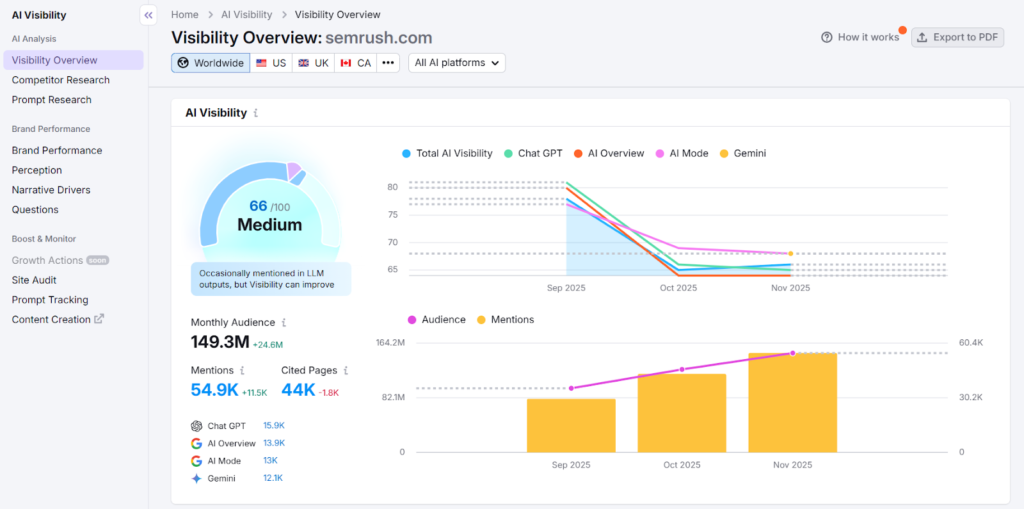
Traditional SEO metrics (rankings, traffic, CTR) still matter. But they don’t show AI search visibility.
You need different metrics:
- Platform breakdown – Where you show up (ChatGPT, Perplexity, AI Overviews)
- Citation frequency – How often your content gets cited
- Mention rate – How often your brand appears in AI responses
- Mention sentiment – Whether mentions are positive, neutral, negative
Without specialized tools, manually search key queries across platforms and track when your brand appears.
Who owns this: Your SEO analyst or whoever handles performance reporting. AI metrics become addition to existing dashboard.
Optimizing Off-Site Signals
AI tools pull from everywhere your brand is mentioned online:
- G2 reviews comparing tools
- Reddit threads discussing your product
- Forum conversations about your industry
- News articles mentioning your company
If mentions are sparse or outdated, AI has less information when someone searches your brand or asks about your product category.
Who owns this: No single person owns this entirely. PR, community management, customer success each control different pieces.
Someone from SEO takes coordination role, ensuring teams understand how their work affects AI visibility.
SEO lead works cross-functionally to align off-site efforts. Works with customer success to encourage reviews on G2 or Trustpilot. Monitors where brand gets mentioned across forums, social platforms, community discussions.
Understanding Platform Differences
Different AI platforms retrieve and display information differently.
I searched “which is the best camera phone of 2025” across three platforms:
ChatGPT cited YouTube videos, Reddit thread, Tom’s Guide, Yahoo, Tech Advisor.
Google AI Mode cited one YouTube video and other websites – no Tom’s Guide, Yahoo, or Tech Advisor.
Claude cited Quora and Android Authority twice. No Reddit, YouTube, or Tom’s Guide.
Same query, completely different sources.
You don’t need separate strategies for each platform. But knowing how platforms prioritize sources helps structure your entire approach.
Who owns this: SEO lead or strategist. Track how brand appears across platforms. Identify what works where. Spot coverage gaps. Work with content, technical, other teams to adjust strategy.
Build, Buy, or Borrow: How to Get These Skills
You have three options: build internally, hire new talent, bring in outside expertise.
Most teams use some combination. The key is knowing which approach works for specific skills.
Build Internally (Usually Best First Move)
Upskilling current team is almost always smartest first move.
They already know your brand, workflows, audience. That context shortens learning curve.
Focus on skills that evolve naturally from what team already does:
- Train writers to structure content for AI extraction
- Help SEO lead understand AI retrieval patterns
- Encourage analyst to track AI visibility metrics alongside rankings
These are logical extensions of existing expertise. Not entirely new disciplines.
Training doesn’t mean building full internal curriculum. Start small:
- Run short internal workshops explaining how AI search retrieves content
- Review recent AI-generated answers for top keywords, note which competitors get mentioned
- Compare their cited passages to yours, update 1-2 articles using those patterns
Upskilling takes a few months before you see real traction. But it’s most sustainable.
Best for: Startups and mid-sized teams with strong SEO foundations but limited budget for new hires.
Watch out for: Don’t overload team with theoretical “AI SEO” training. Focus on skills directly connecting to visibility outcomes. Watch for skill concentration – if one person owns 3+ new AI skills, that’s a bottleneck.
Hire New Talent (When You Need Speed)
Bring in new talent when you need expertise faster than you can build internally.
Makes sense when skill is both specialized and strategic. Something giving long-term edge, not short-term fix.
Examples:
- Data analyst who understands measuring citations and mentions across AI platforms
- Technical SEO who can model entities and implement structured data at scale
- AI content strategist who can guide content alignment with AI retrieval patterns
These hires extend capabilities of existing team. Don’t replace it.
Key to finding right people: clarity before posting job. Decide what outcome you’re hiring for.
Best for: Mid-sized and enterprise teams with budget flexibility wanting to move faster than internal training allows.
Watch out for: Don’t over-index on shiny “AI SEO” titles. Few people have that label yet. Look for specialists in data, structured content, retrieval systems.
Outsource or Consult (For Specialized Projects)
Not every skill is worth building or hiring for. Some are highly specialized. Others you only need short-term.
Outsourcing works best when you need to move fast on projects requiring niche expertise.
Examples:
- Hire consultant to set up AI visibility tracking before analyst takes over
- Partner with content firm to scale passage optimization across hundreds of pages
- Bring in Reddit marketing expert to boost brand presence in relevant subreddits
This gives access to deep expertise without expanding headcount.
Best for: Teams needing quick access to specialized expertise or extra hands for complex, time-bound projects.
Watch out for: Don’t treat outsourcing as default fix. If skill becomes core to strategy, bring it in-house. Choose partners who understand brand voice.
The Reality: 70-20-10 Split
Most teams land somewhere near 70% built internally, 20% borrowed through outside experts, 10% bought as new hires.
Exact ratio matters less than how deliberately you manage it.
As priorities shift, rebalance how team works. Might mean promoting someone internally to own AI visibility, bringing in freelancer for off-site optimization, or hiring analyst to deepen data capability.
3-Phase Roadmap
You don’t need massive reorg. You need plan that builds capability, tests what works, scales what proves effective.
Phase 1: Foundation (First 3 months)
- Assess current capabilities across content, technical, analytical areas
- Establish visibility baseline – search top topics in ChatGPT, Perplexity, AI Overviews
- Pick 2-3 priorities with clearest improvement opportunity
- Run small pilot – update few pages, recheck if updates help brand appear more
- Document key learnings
Goal: Build clarity, alignment, shared understanding of how AI search changes priorities.
Phase 2: Acceleration (Next few months)
- Run training sessions to deepen AI SEO understanding
- Bring content, SEO, analytics, product, brand together under shared visibility goal
- Expand pilot to more pages or campaigns
- Build repeatable workflows – standardize technical, analytical, content tasks
- Use shared dashboards to track AI visibility metrics
- Run monthly reviews
Goal: Build capability, consistency, accountability across AI SEO initiatives.
Phase 3: Scale (Next 6 months)
- Expand proven approaches across full SEO and content programs
- Define who leads AI strategy, measurement, experimentation
- Turn learnings into onboarding sessions, playbooks, process docs
- Assign ownership where consistent work required
- Share quarterly reports with senior stakeholders
Goal: Make AI-first execution routine and scalable.
Measuring Success
Track how often your brand appears in AI-powered answers:
- Citation frequency
- Brand mention rate
- Platform coverage
- Sentiment
Your AI Visibility Score is good overall indicator of team performance.
If it improved over 3-12 months, team is executing well. Skills translating into real visibility.
If results aren’t showing after two quarters, revisit priorities. Might be focusing on wrong skills first or need to adjust build/buy/borrow mix.
Pro tip: Benchmark your brand’s score alongside five competitors. After 3-12 months, compare growth rates, not just final scores.
Your score might increase from 30 to 40 (+10 points). But if competitors jumped from 40 to 60 (+20 points), they’re not just more visible – they’re outpacing you.
AI SEO is built on traditional SEO. But there are more layers. Your team needs updated systems and upgraded skills so your brand gets mentioned and cited in AI search results.
Don’t rebuild your team. Extend what they already do. Focus on natural skill evolution. Hire selectively for specialized gaps. Outsource short-term niche projects.
That’s how you actually future-proof your SEO department.