


Content gap analysis means finding topics your audience searches for that your site doesn’t cover yet, or covers too thinly. To find content gaps with AI, give the model two lists, your published URLs and a competitor’s, and ask it to group both by topic and flag what is missing. Then check each gap against real search data before you write anything.
Key takeaways
- Most gaps are long-tail topics. Ahrefs found that nearly 93% of keywords in its US database get fewer than 10 searches a month.
- AI is fast at comparing topic lists. It cannot tell you search demand, so validate every gap with keyword data.
- You can do the whole thing for free with sitemaps, Search Console and an AI chat tool.
- We ran the method on AI SEO Gazette and found five real gaps. The results are below.
Why content gaps are mostly long-tail
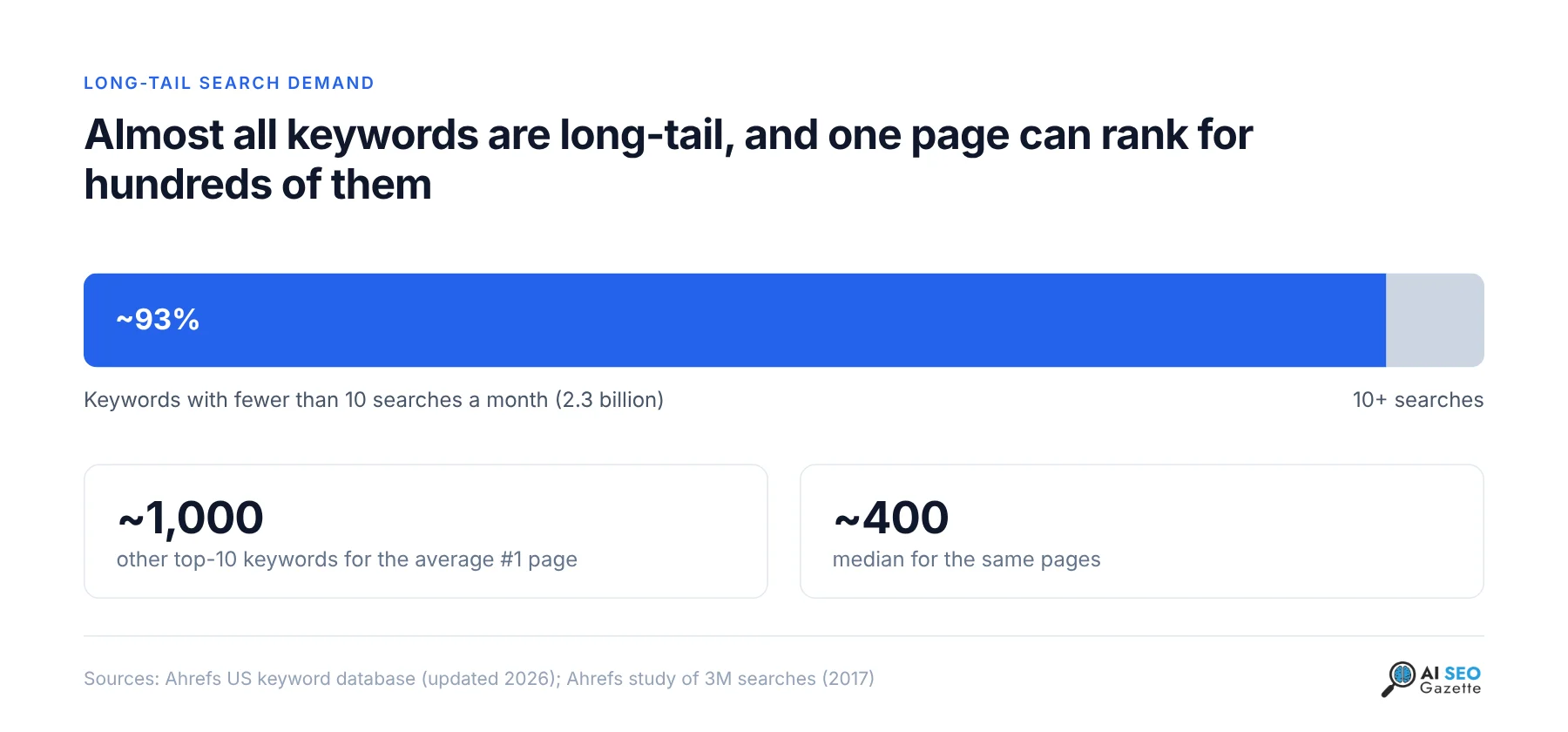
Search demand is spread thin. In Ahrefs’ US keyword database, 2.3 billion keywords get fewer than 10 searches a month, almost 93% of the total. No single one of those is worth a post on its own, but together they make up most of what people search for.
The good news is that one page can cover many of them. An Ahrefs study of 3 million searches (2017) found that the average #1 ranking page also ranks in the top 10 for nearly 1,000 other relevant keywords, with a median of around 400. So a content gap is rarely one missing keyword. It is a missing topic, and one good page can fill it.
That changes how you look for gaps. Comparing keyword lists one by one buries you in thousands of rows. Comparing topics is faster, and it is exactly the kind of grouping work AI is good at.
Three places content gaps come from
- Competitor gaps: topics a competitor covers and you don’t. This is the classic content gap analysis.
- Search Console gaps: queries where your site gets impressions but no page targets the query directly. These are the cheapest to fill, because Google already associates you with the topic. Pull them from the Search Console Performance report.
- Depth gaps: topics you only cover in a news post or a passing mention, with no proper guide behind it.
How to find content gaps with AI, step by step
Step 1: List your own topics
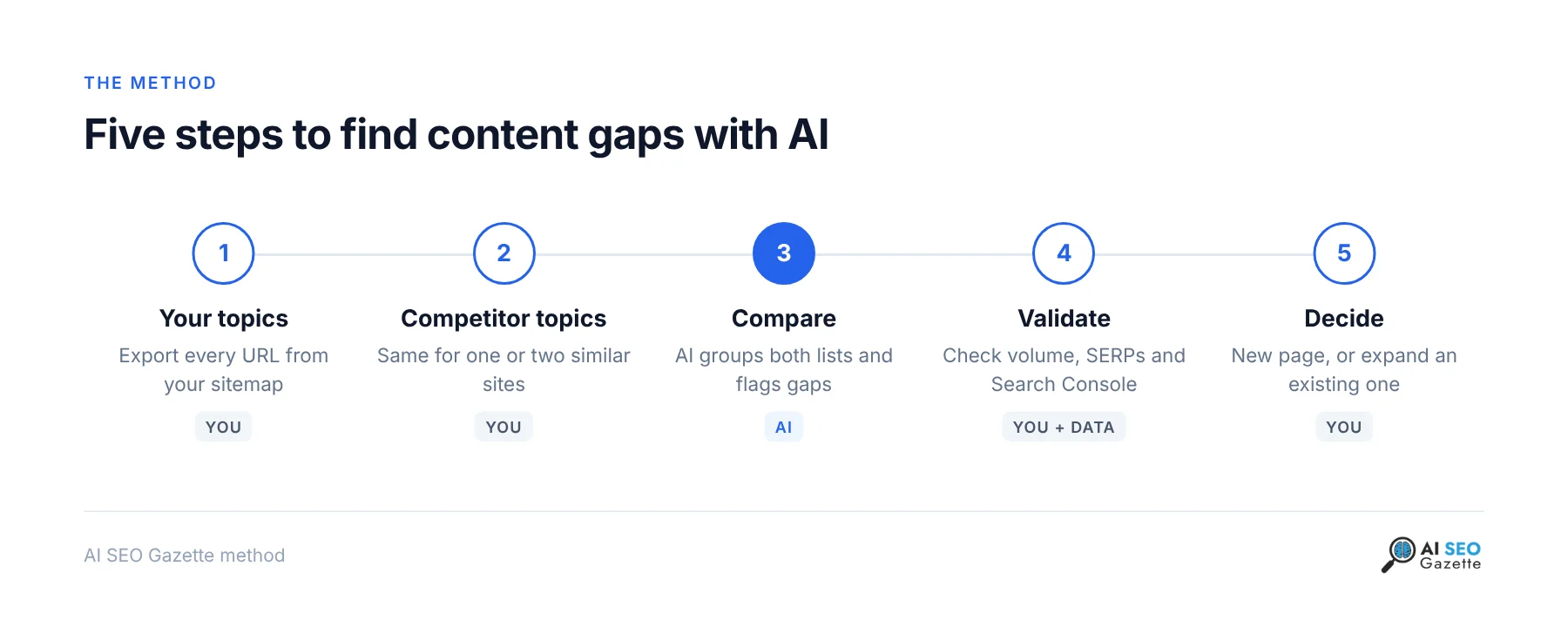
Export every URL from your sitemap. WordPress sites with Rank Math or Yoast have a sitemap index at /sitemap_index.xml. Slugs are usually enough for AI to understand each post’s topic. For more accuracy, add each title.
Step 2: List a competitor’s topics
Do the same for one or two competitors that target your readers. Pick sites closer to your size and niche, not the biggest publisher in the space, or you will get a gap list too long to act on.
Step 3: Ask AI to compare them
Paste both lists into Claude, ChatGPT or Gemini with this prompt:
Below are two lists of blog URLs. List A is my site. List B is a competitor.

1. Group the URLs in both lists into topics (not keywords).
2. For each topic in List B, say whether List A covers it: Yes, Partly (only news or a passing mention), or No.
3. Show only the Partly and No topics, in a table: topic, competitor URL(s), my closest URL if any, and a suggested working title for a new guide.
4. Ignore topics that don't fit my site's focus: [describe your site in one line].

List A:
[paste]

List B:
[paste]
The “ignore topics that don’t fit” line matters. Without it, AI will happily tell you to write about payment processors because a competitor once did.
Step 4: Check the gaps against real data
AI has no idea how many people search for a topic. For each gap, check search volume in a keyword tool, search the topic yourself to see what ranks, and look for impressions in Search Console. Drop anything with no demand and no business reason to exist.
If you would rather not do this by hand, a few tools in our directory help. AnotherSEOGuru turns Search Console data into a work plan, CrakSEO’s MCP servers feed live SEO data into Claude or ChatGPT so the comparison can use real numbers, and SIA SEO crawls your site and suggests keywords that fit it. More options are in the SEO tools directory.
Step 5: Decide new page or existing page
Not every gap needs a new post. If you already have a page that is close, expand it instead. A new post on a topic you half-cover splits your signals across two URLs. Our content audit checklist covers how to spot that kind of overlap.
Worked example: content gaps on AI SEO Gazette
We ran this exact method on our own site in November 2026. List A was every post in our sitemap (about 240 URLs). List B was the blog of seo.ai, a site that also covers AI and SEO, filtered to its AI search topics. Here are the five gaps the AI flagged that held up after a manual check:
| Topic | Our coverage | What we’d write |
|---|---|---|
| Getting products into ChatGPT shopping results | Partly: news only | A step-by-step guide to product feeds for ChatGPT |
| Whether AI crawlers can read JavaScript | Partly: news only | A test of what AI crawlers see on JavaScript-heavy pages |
| Entity SEO | No | Entity SEO for AI search, with examples |
| Turning unlinked brand mentions into links | Partly: news only | A workflow for finding and claiming unlinked mentions |
| Topical maps | No | How to build a topical map with AI |
Three of the five are depth gaps: we covered the news when it broke but never wrote the guide people search for afterwards. That pattern is common on news-led sites, and it is worth checking first if you publish news.
The AI also suggested about a dozen gaps we threw out, mostly ecommerce platform comparisons and Shopify topics that seo.ai covers but that don’t fit our readers. That is why step 4 and the “fit” line in the prompt are there.
Where AI gets content gap analysis wrong
- It invents demand. AI will describe a topic as “popular” or “high volume” with nothing behind it. Only trust numbers from a keyword tool or Search Console.
- It misreads slugs. Short or clever URLs get grouped into the wrong topic. Add titles if the results look off.
- It misses partial coverage. If a topic sits inside a broader post, AI may call it a gap. Search your own site before writing.
- It copies the competitor’s angle. Use the gap list to pick topics, then write your own take with something original in it. Our guide on getting cited in AI Overviews and ChatGPT covers what makes a page worth citing.
Once the new pages are live, link them into the right cluster so they don’t sit alone. Our guide to building content hubs shows how.
Frequently asked questions
What is a content gap analysis?
It is a comparison of the topics your audience searches for against the topics your site covers. The output is a list of missing or thin topics, ranked by how much they matter to your readers and your business.
What is the best content gap analysis tool?
For keyword-level gaps, paid suites like Ahrefs and Semrush have dedicated content gap reports. For topic-level gaps, a free sitemap comparison with an AI chat tool works well, as long as you check demand with keyword data afterwards.
How do I find content gaps on my own website for free?
Export your sitemap and a competitor’s, paste both into an AI chat tool with the prompt above, then check each gap in Search Console and a free keyword tool before writing.
How often should I run a content gap analysis?
Once a quarter is enough for most sites. Run one sooner if a competitor starts outranking you on topics you thought you owned.
Sources
- Ahrefs (updated 2026). Long-tail Keywords: What They Are and How to Get Search Traffic From Them
- Ahrefs, Tim Soulo (2017). How many keywords can you rank for with one page?
- Google Search Console Help. Performance report (Search results)
- seo.ai. Blog (sitemap used for the worked example, November 2026)