
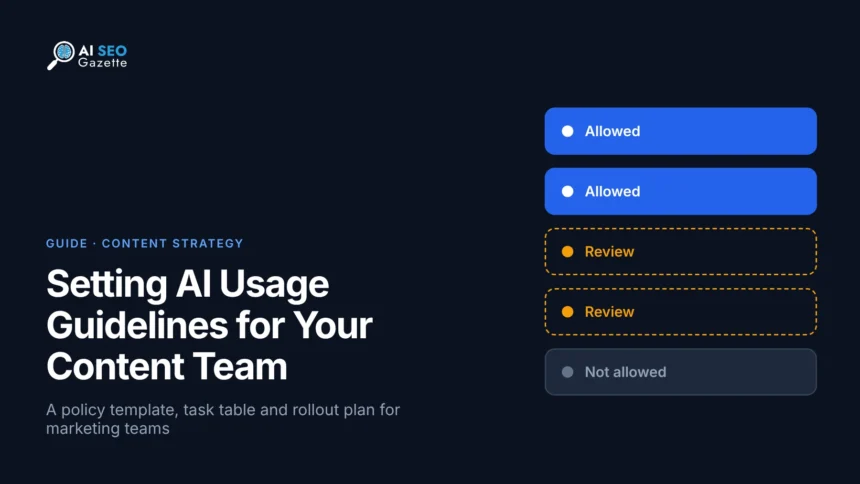

AI content guidelines are a written team policy that says which AI tools staff may use, what data never goes into them, which tasks AI can do alone, which need human review, and which are banned. Good guidelines name who signs off, require fact-checks on every published claim, and get reviewed every quarter.
Most content teams already use AI. Few have written down how. That gap is where the expensive mistakes happen: a freelancer pastes a client’s unreleased roadmap into a free chatbot, an editor ships a statistic nobody checked, or someone spins up 200 location pages in an afternoon. This guide gives you a copy-paste AI usage policy template, a task decision table, and a five-step rollout plan built for marketing and SEO teams.
Key takeaways
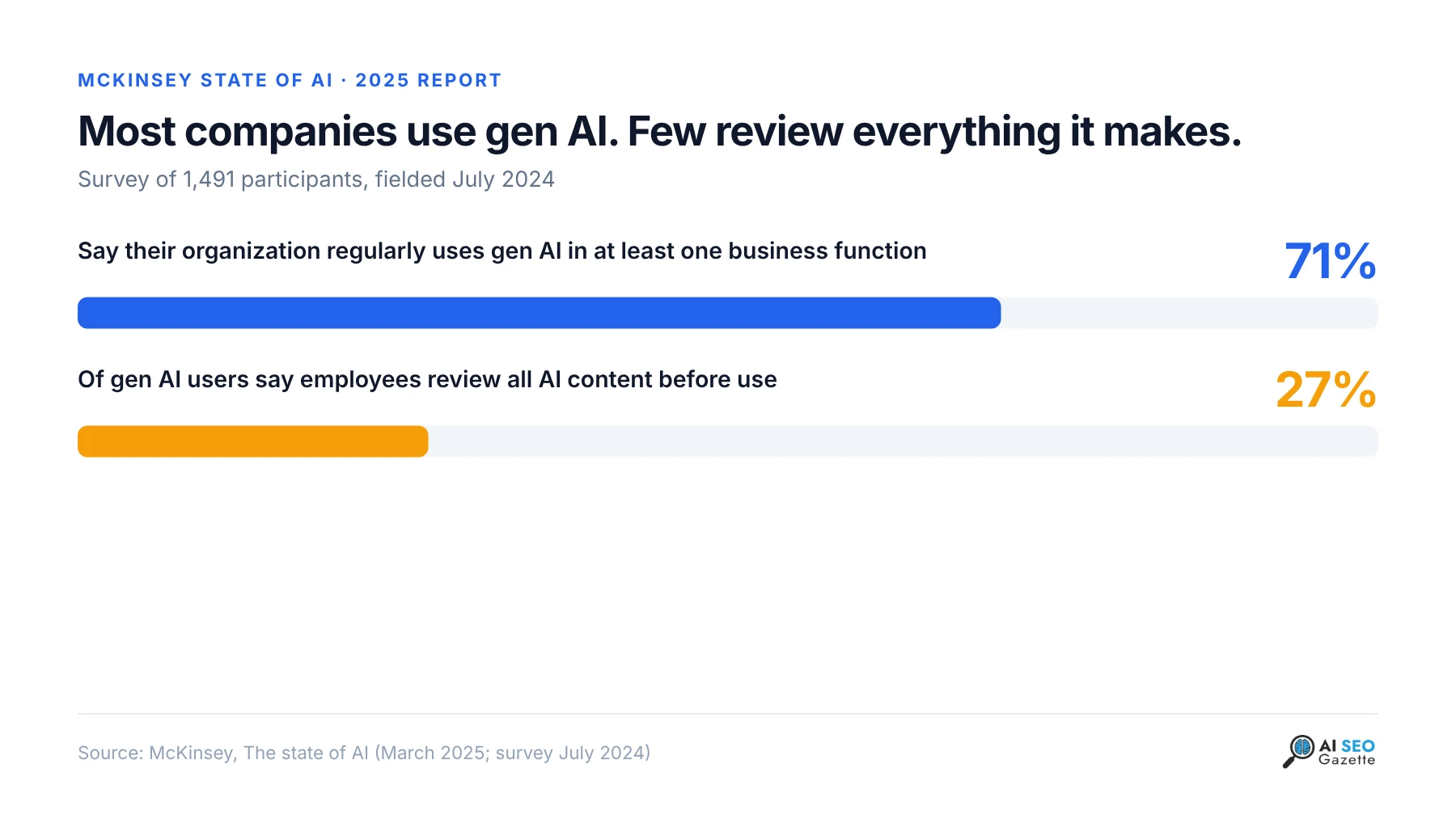
- McKinsey’s survey (fielded July 2024, published March 2025) found 71% of respondents say their organizations regularly use gen AI in at least one business function, but only 27% of gen AI users say employees review all AI content before use.
- Google allows AI-assisted content but says you must manually fact-check and review all of it, including titles, meta descriptions, structured data and alt text.
- The most useful part of any AI policy for marketing teams is a task table: allowed, allowed with review, not allowed, with a named approver for each.
- Data rules matter as much as writing rules. Spell out exactly what staff may never paste into an AI tool.
- Treat the policy as a living document with an owner and a quarterly review date.
Why your content team needs AI content guidelines now
AI use is already the default. In McKinsey’s State of AI survey, published in March 2025 and based on 1,491 participants surveyed in July 2024, 71% of respondents said their organizations regularly use gen AI in at least one business function. Marketing and sales is where organizations most often use it.
Review has not kept pace. In the same survey, 27% of respondents whose organizations use gen AI said employees review all AI-generated content before it is used. A similar share said 20% or less gets checked. McKinsey’s November 2025 follow-up put regular AI use at 88% of respondents, with nearly one-third of all respondents reporting consequences from AI inaccuracy.
So the typical content team uses AI every day and checks only some of what it produces. A written policy closes that gap by turning “use your judgment” into rules people can follow on a deadline.
What Google’s rules mean for your AI content guidelines
Google does not ban AI content. Its February 2023 Search Central post by Danny Sullivan and Chris Nelson says “Appropriate use of AI or automation is not against our guidelines.” What it targets is content made mainly to manipulate rankings.
Two newer documents shape what your policy has to say:
- Review everything. Google’s guidance on using generative AI content (last updated October 1, 2026) says: “It is critical to manually factcheck and review all AI-generated content for accuracy and trustworthiness before publishing.” It adds that this applies to titles, meta descriptions, structured data and image alt text. We covered the update in our news report on Google’s fact-checking guidance.
- No scaled pages without value. Google’s spam policies list “Using generative AI tools or other similar tools to generate many pages without adding value for users” as an example of scaled content abuse.
Your policy does not need to restate Google’s whole philosophy. It needs to translate these two lines into steps: who reviews, what they check, and what volume of AI output needs a manager’s sign-off. For the wider debate on disclosure and honesty, see our practical guide to AI content ethics.
What should an AI policy for marketing teams cover?
A team policy is different from a personal code of ethics. It has to work for staff, freelancers and guest writers who have never met your editor. Keep it to two pages and cover these areas:
- Approved tools. A short list of tools staff may use, which account type (company workspace, not personal free accounts), and who approves new ones. A shared prompt library such as Gud Prompt helps teams keep approved prompts in one place instead of scattered chat histories.
- Data rules. What never goes into an AI tool: client confidential material, personal data, unreleased product details, passwords, contracts.
- Task rules. Which jobs AI may do, which need review, which are off limits (the table below).
- Review standard. What a reviewer checks and how they record it.
- Disclosure and bylines. When readers get told how AI was used. Google’s 2023 FAQ says disclosures are useful “for content where someone might think ‘How was this created?'” and that giving AI an author byline “is probably not the best way” to be clear with readers.
- Ownership. The U.S. Copyright Office’s January 2025 report concluded that prompts alone do not make someone the author of AI output, though human creative arrangement or changes to that output can be protected. If you sell or license content, your policy should require real human authorship on anything you need to own.
- Owner and review date. One named person, and a date.
AI task decision table: allowed, allowed with review, not allowed
This is the part your team will actually use. Print it, pin it in Slack, attach it to every brief. Adjust the approver column to your org chart.
| Task | Status | Who signs off | Why |
|---|---|---|---|
| Brainstorming topics, angles and headlines | Allowed | Writer | Low risk; nothing reaches readers without later editing |
| Outlines built from your own brief and research | Allowed | Writer | The brief sets the facts; AI only arranges them |
| Clustering exported keyword lists | Allowed | SEO lead | Your data in, groupings out; spot-check a sample |
| Grammar and clarity edits on a human draft | Allowed | Writer | Meaning stays with the author |
| Full first drafts | Allowed with review | Editor | Needs fact-checking, original input and voice editing |
| Statistics, quotes, dates and product specs | Allowed with review | Editor, against the original source | Models predict words; they do not look up facts |
| Meta titles, descriptions, alt text and schema | Allowed with review | SEO lead | Google names these as needing review |
| Translations and localization | Allowed with review | Native-speaker reviewer | Errors are invisible to non-speakers |
| AI-generated images | Allowed with review | Editor | Check accuracy and label where expected; Google Merchant Center requires IPTC metadata on AI images |
| Health, legal or financial claims | Allowed with review | Qualified subject expert | High harm if wrong |
| Publishing many similar pages from templates | Allowed with review | Head of content, before launch | Scaled content abuse risk under Google’s spam policies |
| Pasting client, customer or personal data into unapproved tools | Not allowed | N/A | Confidentiality and data protection |
| Writing testimonials, reviews or quotes from real people | Not allowed | N/A | Fabrication, whatever the intent |
| First-hand experience claims (“we tested”) without a real test | Not allowed | N/A | Misleads readers about who did the work |
| Publishing any AI output with no human review | Not allowed | N/A | Breaks Google’s review guidance |
A quick test for anything not on the list: if the output reaches a reader, a client or a search engine, it needs review. If it only shapes your own thinking, it is usually fine.
Copy-paste AI usage policy template
Replace the bracketed parts and delete anything that does not fit. It is short on purpose, because nobody reads a 20-page AI policy.
[COMPANY] AI USAGE POLICY FOR CONTENT
Owner: [NAME, ROLE]   Version: [1.0]   Last reviewed: [DATE]   Next review: [DATE + 3 MONTHS]

1. SCOPE
This policy covers everyone who creates content for [COMPANY]: staff, freelancers, agencies and guest contributors. It applies to text, images, audio, video, metadata and structured data.

2. APPROVED TOOLS
You may use only these tools, through company accounts: [TOOL 1], [TOOL 2], [TOOL 3].
To request a new tool, email [OWNER] with what it does and where it stores data. Do not use personal or free accounts for company work.

3. DATA YOU MUST NEVER ENTER INTO AN AI TOOL
- Client or customer confidential information
- Personal data (names with contact details, health, financial or account information)
- Unreleased products, pricing, roadmaps or financial results
- Contracts, passwords, API keys and internal credentials
If you are unsure, leave it out and ask [OWNER].

4. WHAT AI MAY DO
Follow the AI task decision table attached to this policy. In short:
- Allowed: ideas, outlines from your brief, keyword grouping, grammar edits.
- Allowed with review: drafts, facts and figures, metadata, translations, images, regulated topics, templated pages.
- Not allowed: fake quotes, reviews or testimonials; invented first-hand experience; publishing without human review.

5. REVIEW STANDARD
Before anything AI-assisted is published, a named reviewer must:
- Check every statistic, quote, date and claim against the original source and link it.
- Check titles, meta descriptions, alt text and schema.
- Add original input: our data, examples, screenshots or expert comment.
- Edit for our voice and remove filler.
Record the reviewer's name in [CMS FIELD / TRACKER].

6. DISCLOSURE AND BYLINES
Every piece has a real human byline. Do not list AI as an author.
Add a short note on how AI was used where readers would reasonably expect it: [EXAMPLE WORDING].

7. GUEST AND FREELANCE CONTRIBUTORS
Contributors must tell us which parts were AI-assisted when they submit. Undisclosed AI drafts, invented sources or fabricated experience lead to rejection.

8. OWNERSHIP
Content we need to own must include substantial human authorship. Do not publish raw AI output as a final work.

9. VOLUME LIMITS
Publishing more than [NUMBER] similar or templated pages in a month needs written approval from [HEAD OF CONTENT].

10. MISTAKES AND INCIDENTS
If AI-assisted content goes out with an error, correct it, note the correction on the page where appropriate, and tell [OWNER] within [24 HOURS]. If restricted data was entered into a tool, report it to [OWNER / IT] the same day.

11. REVIEW OF THIS POLICY
[OWNER] reviews this policy every quarter and whenever Google, a regulator or a key tool changes its rules.
If you accept guest posts, section 7 is the one that saves you the most time. Pair it with the screening approach in our guide to using AI detection tools without rejecting good work, and treat detector scores as a prompt for a conversation, not a verdict.
How to roll out AI content guidelines in five steps
A policy nobody follows is worse than none, because it gives false comfort. Roll it out like a process change.

- Audit current AI use. Ask every writer, editor and freelancer which tools they use, for what, and on which account. Expect surprises. Write down the answers without judgment, or people will hide them.
- Set tool and data rules. Pick the approved tools, move people onto company accounts, and write the “never enter” list from section 3 of the template.
- Classify tasks by risk. Fill in the decision table for your own workflow. Add tasks specific to you, such as product descriptions or sales emails, and name an approver for each.
- Train and pilot on live briefs. Run the policy on two weeks of real work. Have reviewers log what they caught, which shows where the rules are too loose or too tight.
- Log, measure and review quarterly. Track reviewer names, corrections and incidents. Revisit the policy every quarter, and sooner when Google updates its guidance.
For the editing side of step 4, our 5-step framework for editing AI content gives reviewers a checklist they can run in under an hour.
Where AI gets it wrong: manual checks the policy should force
These are the failure points a reviewer has to catch by hand. No tool catches them reliably.
- Invented or misdated statistics. AI often cites a real publisher with the wrong year or a made-up figure. McKinsey’s 71% figure, for instance, comes from a survey fielded in July 2024, even though the report was published in 2025. Open the original source every time.
- Dead or wrong links. Click every link. Models produce URLs that look right and return a 404.
- Stale guidance. AI training data lags. Google’s AI content page was updated in October 2026, so a model may not know it yet.
- Generic voice. Drafts drift toward the same safe phrasing. Rewriting tools such as AI Natural Write can smooth phrasing, but only a human adds the examples and opinions that make a piece yours. Our guide to humanizing AI writing ethically covers what to change.
- Metadata nobody reads. Alt text and meta descriptions get skipped in review because they are hidden in the CMS. Google names them explicitly, so add them to the checklist.
- Image provenance. Check whether an image you plan to reuse carries AI metadata or a watermark. SynthID Detector reads Content Credentials and reports whether a SynthID watermark is present.
- Old posts made with AI before the policy. Run an AI content audit on what you already published and fix anything that would fail today’s review standard.
Teams that want the policy, briefs and drafts in one workspace can look at content operations tools like Distinctful, or browse more options in our AI writing tools directory.
Frequently asked questions
What should AI content guidelines include?
At minimum: approved tools, data that must never be entered, a task table (allowed, allowed with review, not allowed), a review standard with a named reviewer, disclosure and byline rules, rules for freelancers and guest writers, an incident process, and an owner with a review date.
Does Google penalize AI-generated content?
No, not for being AI-generated. Google says appropriate use of AI is not against its guidelines. It acts against content made mainly to manipulate rankings, including using AI to generate many pages without adding value, and it says all AI content should be manually fact-checked and reviewed before publishing.
Do we have to disclose AI use on every article?
Google does not require a label on every page. Its 2023 guidance says disclosures are useful where readers might ask “How was this created?” Many teams disclose on heavily AI-assisted pieces and keep a real human byline on everything.
How long should an AI usage policy be?
Two pages or less, plus the task table. Long policies go unread. Put the detail in the table and the review checklist, which people use every day.
How often should we update the policy?
Every quarter, and whenever a key tool changes its data terms or Google updates its guidance. Google’s own AI content page was last updated in October 2026, which shows how quickly the rules move.
Sources
- McKinsey & Company, “The state of AI: How organizations are rewiring to capture value” (March 12, 2025; survey fielded July 16 to 31, 2024). mckinsey.com
- McKinsey & Company, “The state of AI in 2025: Agents, innovation, and transformation” (November 5, 2025). mckinsey.com
- Google Search Central, “Google Search’s guidance on using generative AI content on your website” (last updated October 1, 2026). developers.google.com
- Google Search Central, “Spam policies for Google web search” (scaled content abuse). developers.google.com
- Google Search Central Blog, “Google Search’s guidance about AI-generated content,” Danny Sullivan and Chris Nelson (February 8, 2023). developers.google.com
- U.S. Copyright Office, “Copyright Office Releases Part 2 of Artificial Intelligence Report,” NewsNet Issue 1060 (January 29, 2025). copyright.gov