


Thin content is a page that gives searchers little or no original value: copied, stitched together from other sources, mass-produced, or too shallow to answer the query. To fix it, diagnose each page first, then expand, update, merge or remove it. AI can suggest gaps and stale facts, but a person must verify every change before it goes live.
This guide treats thin content SEO as a diagnosis problem. Most advice jumps straight to “add more words.” That rarely fixes anything, because the cause of a weak page decides the cure, and AI tools are happy to pad a page that should have been merged or deleted.
Key takeaways
- Thin means low value, not low word count. Google says it has no preferred word count.
- Diagnose before you edit: thin, outdated, overlapping and dead pages each need a different fix.
- Ask AI for a list of suggestions with reasons, never a full rewrite you paste in.
- Check every fact, link and date an AI suggests. Cut any figure you cannot trace to its source.
- Only change the visible date when the content has changed in a meaningful way.
Why thin content still costs you rankings
Google made low-value pages a direct target in 2024. When it announced the March 2024 core update, together with new spam policies, it said the combined changes were expected to reduce low-quality, unoriginal content in search results by 40%. After the rollout finished on April 19, 2024, Google updated the same post: the result was a 45% reduction.
The same announcement added a scaled content abuse policy, aimed at many pages made mainly to rank, whether people, automation or both produce them. Google also explained in its Search Central post for creators that its core ranking systems work mostly at the page level, with some site-wide signals on top. So a batch of weak pages can drag on more than its own URLs.

What is thin content?
Google’s spam policies for web search describe the patterns without using one tidy definition. The closest pieces are:
- Scaled content abuse: large amounts of unoriginal content that “provides little to no value to users,” including pages generated with AI tools without adding value, scraped and reworded feeds, and content stitched together from other pages.
- Thin affiliation: affiliate pages whose product descriptions and reviews are copied from the merchant with no original content.
- Scraping: republishing other sites’ content without adding anything original.
Short is not the same as thin. A 300-word page that answers a narrow question well is fine. A 2,000-word page that rewords the top five results is thin.
The word count data backs this up. Backlinko’s 2020 analysis of 11.8 million Google search results found the average first-page result has 1,447 words, but the same study found no direct relationship between word count and rankings. Google’s own guidance on people-first content asks whether you are writing to a word count because you heard Google prefers one, and answers: “No, we don’t.” Use 1,447 as a rough sense of what competing pages look like, not as a target.
Thin content SEO: is the page thin, outdated or both?
Before you open an AI tool, sort each weak page into one diagnosis. Score it on the signals below and pick the row that fits best. If two rows fit, fix the higher one first.
| Diagnosis | Signals you can check | Fix |
|---|---|---|
| Overlapping | Another page on your site targets the same query; both get impressions for it in Search Console; neither ranks well | Merge into the stronger URL, 301 redirect the other |
| Thin | No first-hand data, examples or test; mostly a summary of other pages; stats with no source link; a reader would need to search again | Rebuild with original material, or remove it if you have nothing to add |
| Outdated | Was useful once; now has wrong prices, retired features, old screenshots, a past year in the title, or broken links | Update the facts that changed, keep what still holds |
| Dead | No clicks or impressions for 12 months, no backlinks, no business reason to exist | Delete (410) or noindex; redirect only if a close match exists |
| Healthy but short | Answers a narrow question fully, gets clicks, no errors | Leave it alone |
The last row matters most. A content refresh program that “improves” healthy short pages wastes hours and can hurt pages that already work.
How to fix thin and outdated content with AI suggestions
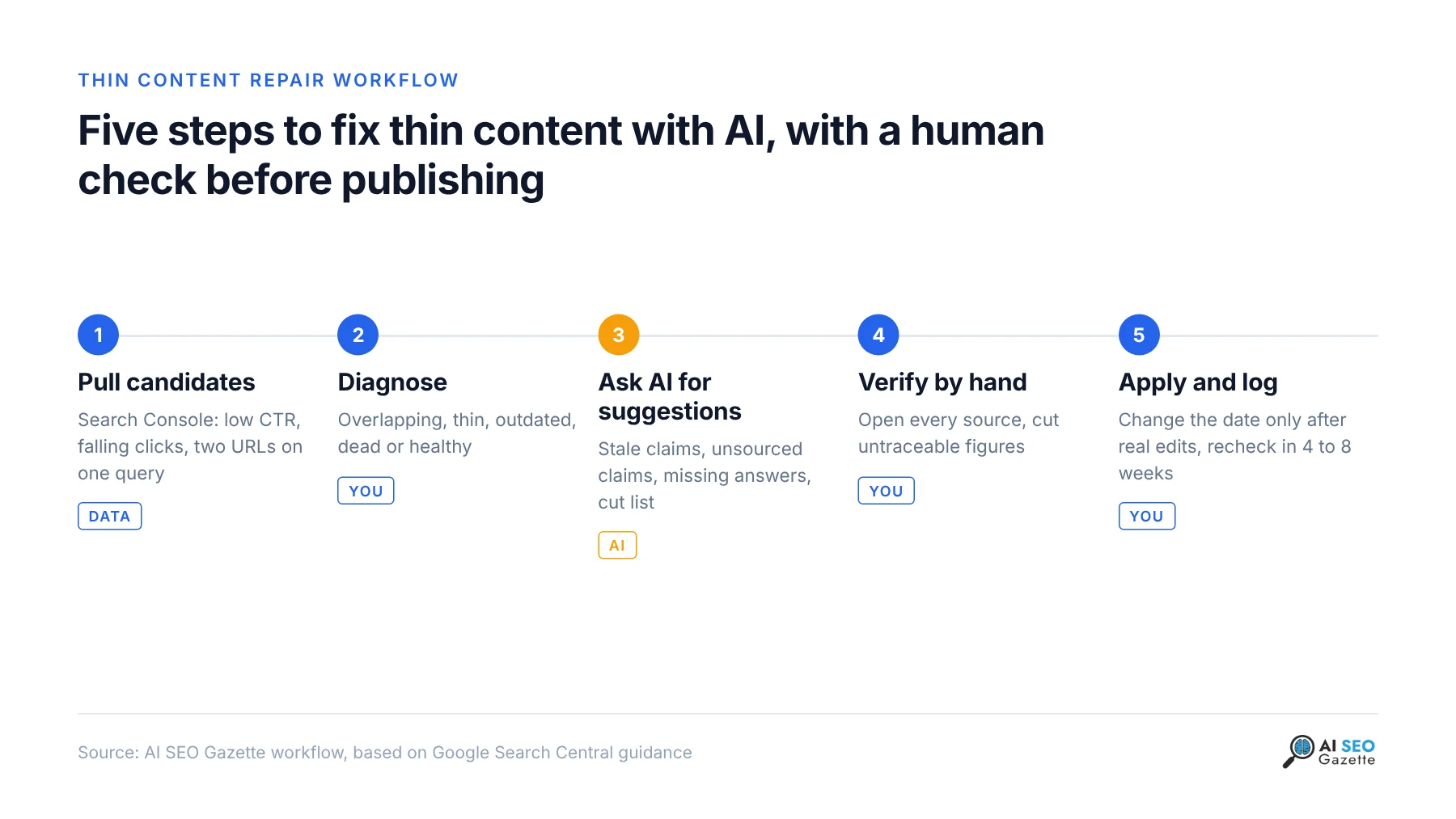
The workflow below keeps AI in the role it is good at, spotting gaps and stale claims fast, and keeps publishing decisions with a person.
Step 1: Pull candidates from data, not gut feel
Export pages from Search Console with 16 months of data and look for three patterns: pages with impressions but almost no clicks, pages whose clicks fell year over year, and queries where two of your URLs swap positions. Tools such as AnotherSEOGuru, which flags content decay and cannibalization from Search Console data, or HyperGSC, which connects Search Console to an AI assistant over MCP, can shorten this step. If you already have an inventory from our AI content audit walkthrough, start from that list.
Step 2: Diagnose each page with the table
Give every candidate one label from the table above before anyone writes a word. This is the step most teams skip, and it is where AI hurts you most if you let it decide. A model asked to “improve” a page will always find something to add, even when the right answer is a redirect.
Step 3: Ask AI for suggestions, not a rewrite
Paste the page text and your diagnosis into the prompt below. It forces the model to separate facts it is sure of from facts it wants you to check, and it lets “do nothing” be a valid answer.
You are reviewing one page on my site. Do not rewrite it.

Page URL: [URL]
Target query: [main keyword]
Published: [date] | Last updated: [date]
My diagnosis: [overlapping / thin / outdated / dead / healthy]
Page text: [paste]

Return four lists:
1. STALE CLAIMS: every statement that may be out of date (prices, features,
   dates, version names, years in titles). Quote the sentence and say why.
2. UNSOURCED CLAIMS: every number or "study" with no link to an original
   source. Quote it. Do not supply a replacement figure.
3. MISSING ANSWERS: questions a searcher for the target query would still
   have after reading. Max 5, ranked by importance.
4. CUT LIST: sentences that add nothing (filler, repetition, generic advice).

Then give one recommendation: update, expand, merge, remove, or leave as is,
with a two-sentence reason. If you are not sure a fact is current, say
"needs check" instead of guessing.
Note the rule on unsourced claims. Asking a model to “fix” a stat invites it to invent a new one with confidence.
Step 4: Verify every suggestion by hand
Google’s guidance on generative AI content says generative models predict likely words rather than retrieve facts, so outputs may contain hallucinations, and it calls manual fact-checking of AI content critical. That review also covers titles, meta descriptions, structured data and image alt text. We covered the change in Google’s fact-checking guidance for AI content. In practice: open each source the AI points to, confirm the number, the year and the sample, and drop anything you cannot trace.
Step 5: Apply the fix and log it
Make the edits yourself or through a tool you control, then record the URL, the diagnosis, what changed and the date in your audit sheet. If an AI agent has write access to your CMS, read our stop test for AI SEO agents before you let it publish. Recheck the page in Search Console after four to eight weeks.
Worked example: one of our own thin pages
We ran the diagnosis on our own post How to Optimize Content for Google AI Overviews in 2026. These are the numbers we measured on November 17, 2026:
- Age: published April 25, 2026, never updated. That is 206 days.
- Length: 356 words of body text, about a quarter of Backlinko’s 1,447-word first-page average. Length alone does not make it thin, so we kept reading.
- Sources: four statistics (“13-48% of searches,” “26-50% of sub-queries,” a “41%” citation lift and “25.5%” of results with ads). None links to the study it came from. Two point to a website’s homepage, and two have no link at all.
- Links: four links in total, one of them to our Write for Us page, and zero to related guides on our site.
- Images: none.
- Overlap: four more posts published April 24 to 26, 2026 target almost the same query, each between 376 and 460 words, among them “How Do I Optimize My Content for Google AI Overviews?”
- Date risk: “in 2026” in the title will look stale in January.
Diagnosis: overlapping first, thin second. It is not mainly outdated, because the problem was never stale facts. The page had no original material and no traceable sources from the day it went up.
Fix: merge the five posts into one guide on the strongest URL, 301 redirect the other four, and drop the year from the title. Each of the four statistics either gets traced to its original study, with the year and sample stated, or gets cut. The merged page then needs something none of the five had: a test or example of our own.
This case shows the trap in “expand thin content.” An AI asked to grow this page to 1,500 words would have produced a longer page that still competes with four siblings and still repeats four untraced numbers. The content gap method helps decide what the merged page should add.
How to update outdated content without faking freshness
Google’s people-first guidance lists two warning signs worth printing out. One asks whether you are changing the date of pages to make them seem fresh when the content has not substantially changed. The other asks whether you are adding or removing a lot of content mainly to make the site seem “fresh,” and says plainly that it won’t help.
So when you update outdated content:
- Change the visible “updated” date only after a real change: new facts, new sections, corrected data, new examples.
- Replace the specific facts that changed. Keep the parts that still hold instead of rewording them for the sake of change.
- Remove years from titles and slugs unless the year is the point of the page, like an annual report.
- Recheck every outbound link. Old posts tend to point at pages that moved or now say something else.
- Add one thing a competitor cannot copy: your own numbers, a screenshot from your account, a test result.
For the full recurring routine, see our evergreen content audit checklist. This guide is the repair step that follows it.
Where AI gets thin content wrong
- It treats short as thin. Models tend to recommend expanding almost anything under 1,000 words. Check the “healthy but short” row before you accept that.
- It cannot see your other pages. Unless you paste in a list of your URLs, a model will suggest adding sections that already exist elsewhere on your site and create new cannibalization.
- It fills gaps with invented facts. Ask for a missing stat and you may get a plausible number with a real-sounding publisher. Every figure needs a source you have opened yourself.
- Its knowledge has a cutoff. A model may call a retired feature current or a current one new. Check product names, prices and policy dates against the official page.
- It flattens voice. Suggestions drift toward generic phrasing. Keep first-hand detail, even when the model marks it as “informal.”
- It never recommends deleting. Unless you ask, AI almost always suggests adding. Make “remove” and “merge” explicit options, as the prompt above does.
Page-level audit tools help with the mechanical part. SEO Idea Creator runs a public page audit of on-page structure and metadata and drafts content suggestions, which, as its listing says, need human review. You can browse more options in our SEO tools directory.
Frequently asked questions
How many words make a page thin?
None. Google says it has no preferred word count, and Backlinko’s 2020 study of 11.8 million results found no direct link between word count and rankings. A page is thin when it adds little original value for the query, whatever its length.
Should I delete thin content or improve it?
Improve it if the topic matters to your readers and you have something original to add. Merge it if another page on your site covers the same query. Delete or noindex it if it gets no traffic, has no links and serves no business purpose.
Can Google penalize AI-generated content?
Google targets low-value content, not the tool used to make it. Its spam policies list using generative AI to produce many pages without adding value as an example of scaled content abuse, and its AI guidance says to fact-check AI output before publishing.
How often should I update outdated content?
Update a page when its facts change or its performance drops, not on a fixed calendar. Review fast-moving topics such as tool pricing or Google features every few months, and evergreen how-to pages once or twice a year.
Does changing the published date help rankings?
Not on its own. Google’s people-first guidance lists changing dates to make pages seem fresh, without substantial changes, as a warning sign. Change the date only after a real update.
Sources
- Google, “New ways we’re tackling spammy, low-quality content on Search” (March 5, 2024, updated April 26, 2024): blog.google
- Google Search Central Blog, “What web creators should know about our March 2024 core update and new spam policies” (March 5, 2024): developers.google.com
- Google Search Central, “Spam policies for Google web search”: developers.google.com
- Google Search Central, “Creating helpful, reliable, people-first content”: developers.google.com
- Google Search Central, “Google Search’s guidance on using generative AI content on your website”: developers.google.com
- Backlinko (Brian Dean), “We Analyzed 11.8 Million Google Search Results. Here’s What We Learned About SEO” (2020): backlinko.com