

AI content ethics means using AI in ways that keep readers informed and protected. A human checks every fact before it goes live. You tell readers how AI was used when they would expect to know. You never fake reviews, experience or authorship. And you don’t mass-produce pages to game rankings. Google allows AI content; it acts against manipulation.
Most arguments about AI content ethics get stuck on one question: is AI writing allowed? That question was settled years ago. The harder questions are practical. Which tasks can you hand to a model? When do you owe readers a disclosure? What happens when a tool founder asks a model to write testimonials? This guide answers those with Google’s own wording, the relevant FTC rule, the US Copyright Office’s position, and a disclosure policy you can copy.
Key takeaways
- Google says appropriate use of AI is not against its guidelines. Using it mainly to manipulate rankings is spam.
- Google’s current guidance calls manual fact-checking of all AI-generated content “critical” before you publish.
- Disclose AI use where a reader would reasonably wonder how a page was made, and label AI images as AI.
- Fake reviews and testimonials, including AI-generated ones, are banned under an FTC rule in force since October 21, 2024.
- Prompts alone don’t make you the author. The US Copyright Office protects only the human creative contribution.
Why AI content ethics matters for rankings and readers
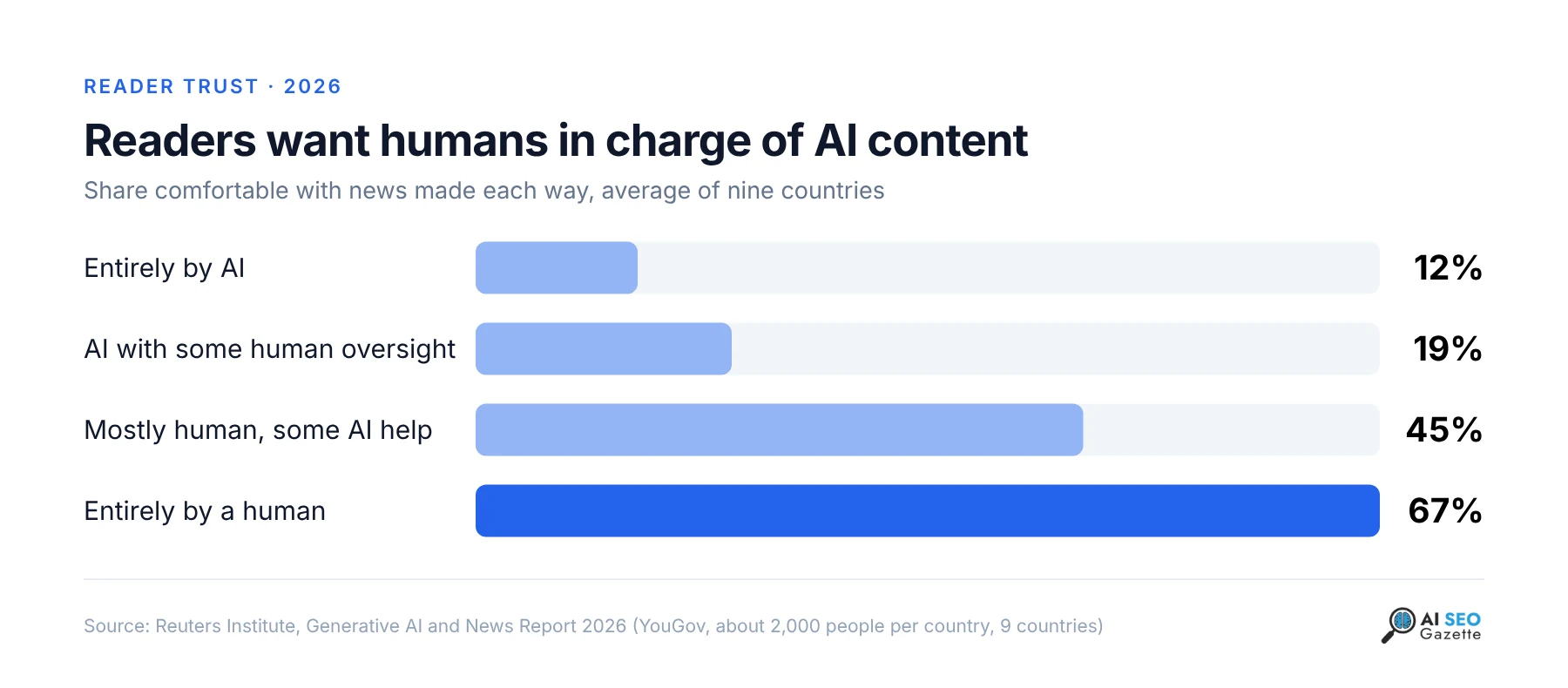
Readers are still wary of content made mostly by machines. In the Reuters Institute’s Generative AI and News Report 2026, a YouGov survey of about 2,000 people in each of nine countries, just 12% said they were comfortable with news made entirely by AI. That rose to 19% with some human oversight, 45% for news made mostly by a human with help from AI, and 67% for news made entirely by a human journalist.
That survey is about news, but the pattern carries over to blogs and SEO content. Readers don’t object to AI help. They object to AI doing the job alone. Comfort with the human-led option is more than double the AI-with-oversight option.
Search engines draw a similar line. When Google announced its March 2024 core update and new spam policies, it said the changes would cut low-quality, unoriginal content in results by 40%. After the rollout, it updated the post on April 26, 2024 to report a 45% reduction. The same announcement aimed its new scaled content policy at pages made to rank “whether automation, humans or a combination are involved.” The method doesn’t matter to Google. The intent and the value to readers do.
What does Google actually say about AI-generated content?
Three Google documents cover almost every question SEOs ask about this.
February 2023: AI is allowed. In Google Search’s guidance about AI-generated content, published February 8, 2023 by Danny Sullivan and Chris Nelson, Google wrote: “Appropriate use of AI or automation is not against our guidelines.” The same post says that using automation, AI included, to generate content with the primary purpose of manipulating ranking in search results breaks its spam policies.
March 2024: scaled content abuse. Google introduced its scaled content abuse policy in the same March 2024 update. Scaled content abuse is when many pages are generated for the primary purpose of manipulating rankings. It covers human content farms as well as AI ones. Our coverage of Google’s June 2026 spam update and AI abuse shows how that policy keeps getting enforced.
October 2026: check everything by hand. Google’s page on using generative AI content on your website (last updated October 1, 2026) says generative AI can be useful for research and for adding structure to original content. It also says: “It is critical to manually factcheck and review all AI-generated content for accuracy.” We covered that change in Google’s fact-checking guidance for AI content.
Put together, Google judges the output and the purpose. It doesn’t penalize a page for being written with AI.
When should you disclose AI use?
Google doesn’t require a blanket AI label on web pages. Its 2023 FAQ says AI or automation disclosures are useful for content where someone might wonder how it was created, and suggests adding them when readers would reasonably expect them. The 2026 guidance asks you to consider telling readers how content was created “in a way that makes sense for your audience.”
That gives you a usable test: would a reasonable reader feel misled if they found out later? A grammar pass doesn’t need a label. A product roundup drafted by a model, a “hands-on” review, or an image that looks like a real photo does.
Images and shopping data have firmer rules. Under the Merchant Center policies cited in the same Google page, AI-generated images must carry IPTC DigitalSourceType TrainedAlgorithmicMedia metadata, and AI-generated product titles and descriptions must be specified separately and labeled as AI-generated. If you need to check an image you didn’t make, a tool such as SynthID Detector reads Content Credentials and AI metadata and reports whether a SynthID watermark is present.
Regional law can go further than Google. If you publish to EU audiences, read our explainer on the EU AI Act’s rules for AI content disclosure.
Ethical use of AI in content: a task-by-task decision table
Use this table when you brief writers or set rules for a content team. “Human review” means a named person checks facts, links and claims before publishing.
| Task | OK with human review? | Disclose to readers? | Line you don’t cross |
|---|---|---|---|
| Research, outlines, briefs | Yes | Usually no | Citing a source you haven’t opened yourself |
| Grammar, clarity, trimming | Yes | No | Letting edits change the meaning of a quote or figure |
| Drafting sections of an article | Yes, with a named editor | Yes, when AI wrote a large share or readers would ask | Publishing unedited drafts in bulk |
| Images and illustrations | Yes | Yes, and add IPTC metadata for Merchant Center product images | Passing off an AI image as a real photo of a product, place or event |
| Tool reviews and roundups | Only to summarize your own testing notes | Yes | Claiming hands-on testing that never happened |
| Customer reviews and testimonials | No | Not applicable | Writing or buying reviews from people who don’t exist |
| Programmatic or templated pages | Only where each page adds unique data | Explain the data source | Many near-identical pages made mainly to rank |
AI ethics in marketing: reviews, testimonials and tool claims
This section matters most to tool founders and anyone who writes landing pages. On August 14, 2024, the FTC announced a final rule banning fake reviews and testimonials. It covers reviews that misrepresent that they are by someone who does not exist, “such as AI-generated fake reviews,” and it lets the FTC seek civil penalties against knowing violators. The rule took effect October 21, 2024, according to its Federal Register notice.
In practice, for a SaaS or AI tool:
- Don’t ask a model to “write five customer testimonials” for your homepage, even as placeholders you plan to swap later. Placeholders have a habit of shipping.
- Don’t post AI-written reviews of your tool on directories, or of a competitor’s.
- Do use AI to summarize real reviews, and link or attribute them to the real customers who wrote them.
- Keep the claims in your tool listing to features you can show working. “Detects 100% of AI text” is a claim you’ll have to prove.
The same applies to affiliates and reviewers. A tool roundup that implies testing, written by a model that never touched the product, misleads readers whether or not it ranks.
Who owns AI-written content?
In the US, copyright protects human authorship. On January 29, 2025, the US Copyright Office released Part 2 of its Copyright and Artificial Intelligence report, on copyrightability. It concluded that AI output is protected only where a human author has determined sufficient expressive elements, which can include creative arrangements or modifications of the output, “but not the mere provision of prompts.”
For bloggers this has a direct consequence. A page that is raw model output may give you little to defend if someone copies it. The parts you wrote, restructured or substantially edited are what you own. That is one more reason to treat AI as a drafting aid rather than the author.
Copy-paste AI content disclosure policy
Publish this on your site (an “Editorial policy” or “How we use AI” page works) and adjust the bracketed parts. It is a template, not legal advice.
How [Site name] uses AI
We use AI tools to help with research, outlines, first drafts and editing. Every article is reviewed by a named editor before it is published. That editor checks each fact, statistic, quote and link against its original source, and removes anything we cannot verify.
We do not use AI to write reviews or testimonials, to invent quotes, or to claim testing or experience we don’t have. When we say we tested a tool, a person on our team used it.
AI-generated images are labeled in their captions. We don’t present AI images as real photos of products, people or events.
Where AI wrote a large part of an article, we say so at the end of the article. If you spot an error, email [address] and we will correct it and note the change.
Last reviewed: [date]
Short per-article lines you can use:
- Light use: “Drafted with AI assistance. Researched, fact-checked and edited by [name].”
- Images: “Illustration created with [tool]. Not a photograph.”
- Heavy use: “Most of this article was drafted by AI from [name]’s notes and testing, then checked line by line by [name] on [date].”
Guest posts need the same rules. If you accept contributors, put the policy in your guest post guidelines and ask each writer which parts of their draft used AI.
Worked example: we scored one of our own guides
To test the policy, we ran a five-point ethics check on a real Gazette page: our guide to fixing thin and outdated content with AI suggestions, published November 17, 2026. We read the live page and its source code on November 18, 2026.
| Check | What we looked for | Result |
|---|---|---|
| Named author | Byline linked to an author page that loads | Pass. “By Dhruv” links to an author page that returns status 200. |
| Visible date | A date readers can see that matches the page markup | Pass. “Last updated: November 17, 2026” matches the dateModified value. |
| Primary sources | Claims linked to the original publisher | Pass. Six unique external sources, five of them Google’s own pages. |
| Dated statistics | Each figure carries its year in the text | Pass. The 40% and 45% figures are tied to the 2024 update. |
| How it was made | A note on how AI was used | Gap. The page has no line explaining AI’s role in producing it. |
Four passes and one gap. The gap stands out because the article is about using AI suggestions, so a reader could fairly ask whether AI helped write it. Google treats this as something to consider, not a requirement, and the fix takes one sentence, such as the “light use” line above. Bylines and dates usually come from the theme. A disclosure has to be written by someone, which makes it the easiest item to forget when you run this check on your own site.
For a full review of older posts, pair this check with our AI content audit process for existing posts.
Where AI gets it wrong: manual checks before you publish
Google’s 2026 guidance explains why review is needed: generative models predict likely sequences of words rather than retrieving facts, so their output can be wrong. These are the errors we see most in AI drafts about SEO and AI tools.
- Wrong year or publisher. Models often attach a real statistic to the wrong study or year. Open the original and match the number, the year and the publisher.
- Invented sources. A plausible URL that returns a 404, or a report title that doesn’t exist. Click every link.
- Stronger claims than the source. “Google requires” when Google says “consider.” Compare the verb in your draft with the verb in the source.
- Fake first-hand experience. “In our testing” or “we found” in a draft where nobody tested anything. Delete it or go do the test.
- Stale tool details. Pricing, limits and features change. Check the tool’s current listing before you publish.
- Thin pages at scale. Twenty city or tool pages with the same paragraphs and swapped nouns. Our guide to thin content SEO covers how to merge or cut them.
Be careful with what tools can and can’t do here. An AI detector such as the one in AI Natural Write can flag drafts that need a closer edit, but a detector score says nothing about whether the facts are right. Humanizers like HumanEnough change phrasing; they don’t verify claims or remove the need to disclose. Using one to hide heavy AI use from readers who expect to know defeats the point of a disclosure policy. You can compare more options in our AI writing tools directory.
For the editing pass itself, our 5-step framework for editing AI content for E-E-A-T walks through it section by section.
Frequently asked questions
Is it unethical to use AI to write blog posts?
No. Using AI for research, drafting or editing is not unethical in itself, and Google said in 2023 that appropriate use of AI is not against its guidelines. It becomes a problem when the content misleads readers, contains unchecked errors, fakes experience, or is produced in bulk mainly to rank.
Does Google penalize AI-generated content?
Google doesn’t penalize content for being made with AI. It acts against content made mainly to manipulate rankings, which its spam policies call scaled content abuse, whether people, automation or both produced it. Low-value pages also tend to lose ground in core updates.
Do I have to label AI-generated content on my blog?
Google doesn’t require a label on web pages, but it suggests telling readers how content was made where they would reasonably expect it. Firmer rules apply to AI images and product data in Google Merchant Center, and laws such as the EU AI Act may apply depending on where you publish.
Can I use AI to write testimonials or reviews for my tool?
No. The FTC’s rule on fake reviews and testimonials, in effect since October 21, 2024, covers reviews by people who don’t exist, including AI-generated ones. You can use AI to summarize genuine reviews, as long as you attribute them to the real customers.
Can I copyright an article written with AI?
In the US, only the human contribution is protected. The US Copyright Office said in January 2025 that prompts alone are not enough, while human creative arrangement or modification of AI output can be protected. Substantial human writing and editing gives you a stronger claim.
Sources
- Google Search Central, “Google Search’s guidance about AI-generated content” (February 8, 2023): developers.google.com/search/blog/2023/02/google-search-and-ai-content
- Google, “New ways we’re tackling spammy, low-quality content on Search” (March 5, 2024, updated April 26, 2024): blog.google/products/search/google-search-update-march-2024
- Google Search Central, “Google Search’s guidance on using generative AI content on your website” (last updated October 1, 2026): developers.google.com/search/docs/fundamentals/using-gen-ai-content
- Reuters Institute for the Study of Journalism, “Generative AI and News Report 2026: From standalone tools to information infrastructure” (October 29, 2026): reutersinstitute.politics.ox.ac.uk
- Federal Trade Commission, “Federal Trade Commission Announces Final Rule Banning Fake Reviews and Testimonials” (August 14, 2024): ftc.gov
- US Copyright Office, “Copyright Office Releases Part 2 of Artificial Intelligence Report” (NewsNet Issue 1060, January 29, 2025): copyright.gov/newsnet/2025/1060.html