

To humanize AI content in a way Google trusts, edit for substance first and style second. Check every fact against its original source, add experience and examples only you have, cut filler, and put an accurate byline on it. Google ranks helpful pages however they are produced. It treats mass-produced, unedited pages as spam.
Key takeaways
- Google does not penalize AI use by itself. It penalizes pages made mainly to manipulate rankings, “no matter how it’s created.”
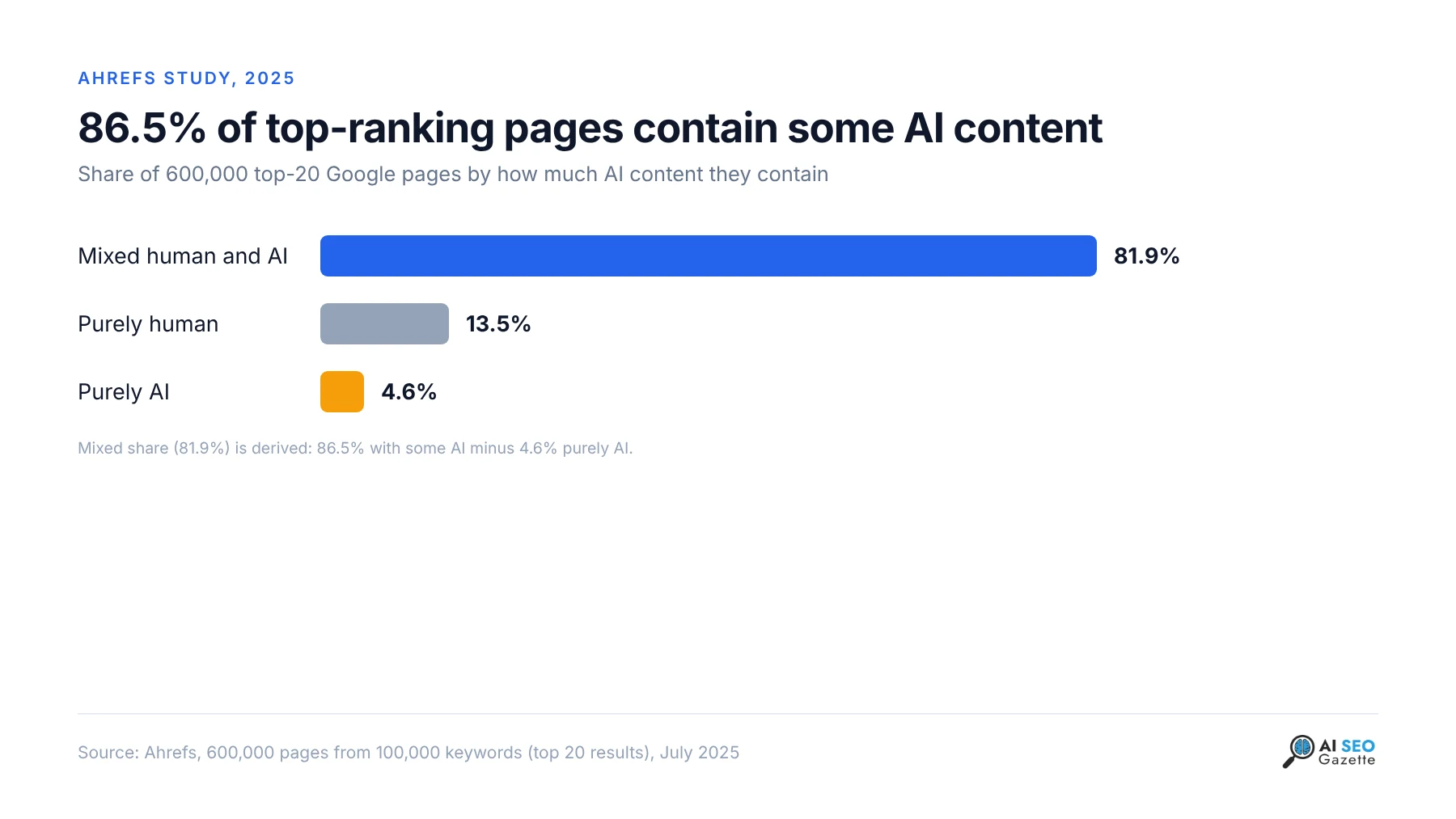
- In Ahrefs’ 2025 study of 600,000 ranking pages, 86.5% contained some AI content and only 4.6% were purely AI.
- Swapping words with a humanizer tool is not the fix. Google’s spam policy names automated “synonymizing” as an obfuscation technique.
- The edits that matter add things a model can’t: verified facts, first-hand detail, a point of view and a real author.
Why it matters: almost every top page now has some AI in it
In July 2025, Ahrefs analyzed 600,000 pages ranking in the top 20 for 100,000 random keywords. Its AI detector found that 86.5% of those pages contained some AI-generated content. Only 4.6% were purely AI, and 13.5% were purely human.
The correlation between the share of AI content on a page and its ranking position was 0.011. Ahrefs called that “effectively zero.” The authors also flagged the obvious caveat: no AI detector is perfect, so treat the split as an estimate.
Two things follow. First, using AI is normal, and Google is clearly not filtering it out. Second, the pages that rank are overwhelmingly mixed: a person shaped what the model produced. That editing step is where ranking pages and spam part ways.
What does Google’s AI content policy actually say?
Google has repeated the same position since 2023. Its February 2023 post, Google Search’s guidance about AI-generated content, puts it in one line: “Appropriate use of AI or automation is not against our guidelines.” What crosses the line is using automation “with the primary purpose of manipulating ranking in search results.”
Three current documents fill in the detail:
- The generative AI guidance. Google Search’s guidance on using generative AI content on your website says AI “can be particularly useful when researching a topic, and to add structure to original content.” It also says: “It is critical to manually factcheck and review all AI-generated content for accuracy and trustworthiness before publishing.” That review covers title elements, meta descriptions, structured data and image alt text too.
- The spam policies. Google’s spam policies define scaled content abuse as “when many pages are generated for the primary purpose of manipulating search rankings and not helping users.” The examples include generating many pages with AI “without adding value for users” and automated transformations such as “synonymizing, translating, or other obfuscation techniques.”
- The helpful content guidance. Creating helpful, reliable, people-first content asks whether a page offers “original information, reporting, research, or analysis” and first-hand expertise. On E-E-A-T it says “trust is most important.” It also warns against “deceptive authorship information” and suggests AI disclosures where readers would reasonably expect them.
Read together, the rule is simple. Google doesn’t care whether a model typed the first draft. It cares whether a person added value, checked the facts and stood behind the page. The synonymizing line matters most for anyone selling or buying humanizer tools: running a draft through a word spinner to dodge detection is close to what the policy describes as obfuscation.
We cover disclosure and authorship ethics separately in our guide to AI content ethics. This article sticks to the editing work.
How to humanize AI content: the editing workflow
Most “humanizing” advice stops at tone. Tone is the last step. Here is the order we use on AI SEO Gazette drafts, with who owns each step.
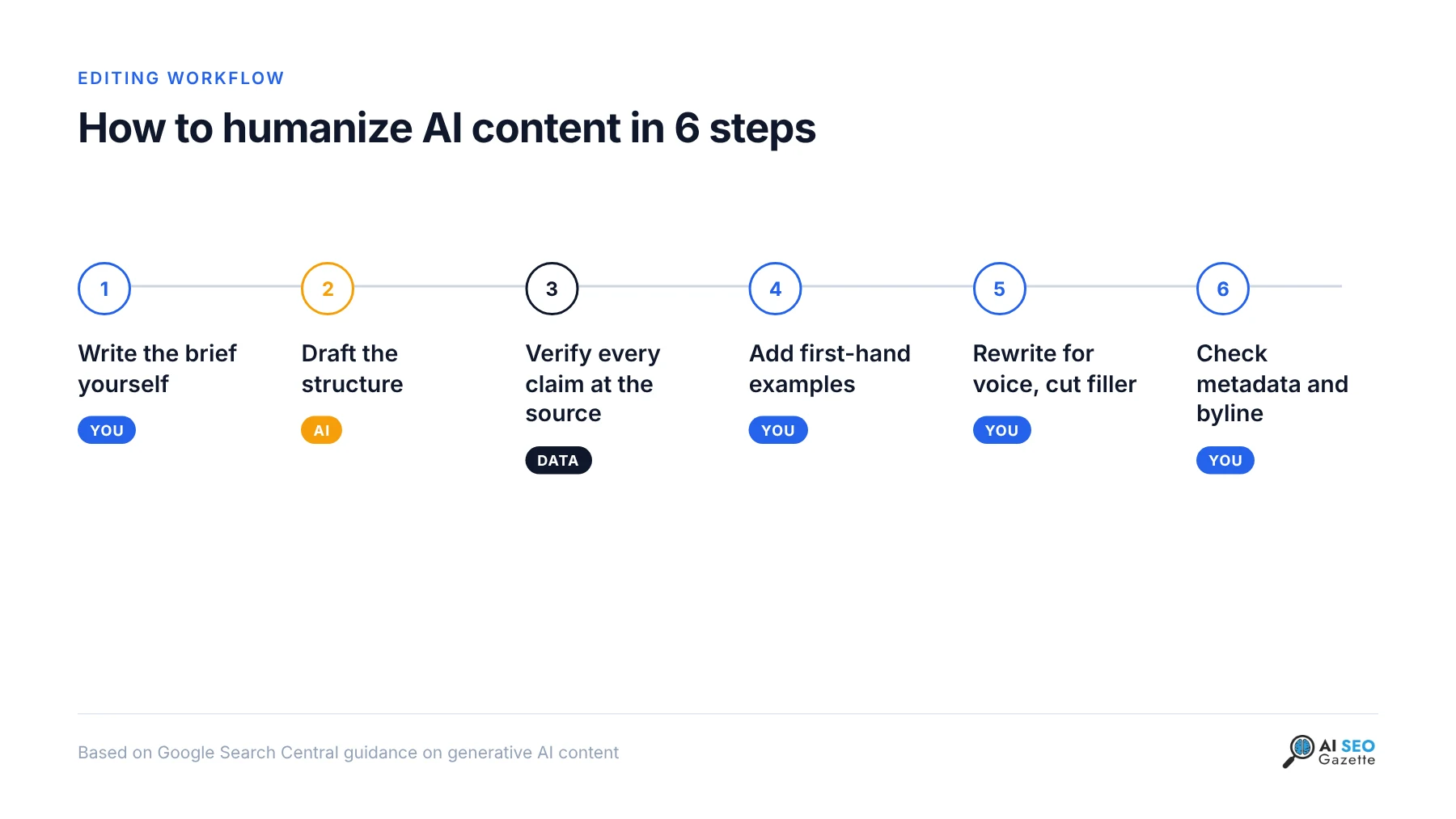
1. Write the brief yourself
Give the model your angle, your audience and the evidence you already have. A draft built on a generic prompt comes back generic, and no amount of editing gives it a point of view it never had.
2. Let AI draft the structure
This is the use Google names as helpful: research help and structure. Ask for an outline and a rough draft. Don’t ask it for statistics.
3. Verify every claim at the source
Open the original study or document for each number, name and date. Check the year, the sample size and the publisher. If you can’t find the source, cut the claim. Our post on Google’s fact-checking guidance for AI content covers why this step now carries extra weight.
4. Add what only you know
Screenshots from your own accounts, a result from a test you ran, a client mistake you fixed, a number from your own analytics. This is the “original information” Google’s helpful content questions ask about, and a model can’t invent it honestly.
5. Rewrite for voice and cut filler
Now fix the sound. Delete the throat-clearing intro, the recap at the end and any sentence that would fit on any site. Vary sentence length. Replace abstract claims with specifics.
6. Check metadata and the byline
Google’s generative AI guidance applies the same review to titles, meta descriptions, structured data and alt text. Put a real author on the page, someone who did the review and can answer for it.
How to make AI content sound human without faking it
Sounding human is a side effect of having something to say. Still, AI drafts share habits that readers spot fast. These are the ones we fix most often:
- Vague attribution. “Studies show” or “experts suggest” with no name or link. Name the source and link it, or delete the sentence.
- Inflated vocabulary. “Utilize,” “holistic approach,” “a testament to.” Use the plain word.
- Identical rhythm. Every sentence 15 to 20 words, every paragraph four sentences. Break the pattern on purpose.
- Empty summaries. Closing lines like “By following these steps, you can succeed.” Cut them.
- Hedged everything. If you tested it, say what happened. If you didn’t, say that.
A humanizer tool can speed up the sentence-level pass. Tools listed in our directory such as AI Humanize, which shows a side-by-side review with manual editing, AI Natural Write and HumanEnough rewrite AI phrasing into more natural language. Use them on step 5, after the facts and the first-hand material are in. A rewrite tool can’t check a statistic or add an experience, and a rewrite that only changes wording adds no value in Google’s terms.
Copy-paste edit prompt
We use this prompt to get a second opinion on a draft before the human edit. It asks the model to flag problems, not to rewrite, so the decisions stay with the editor.
You are a strict editor. Review the draft below. Do not rewrite it.
Return a table with three columns: Quote, Problem, Fix needed.

Flag:
1. Every factual claim, number, date or name. Mark each "VERIFY" and say
   what original source would confirm it.
2. Any claim attributed to "studies", "experts" or "research" with no
   named source.
3. Sentences that would fit on any website about this topic
   (generic filler).
4. Places where a first-hand example, screenshot or result from our own
   work would make the point stronger. Say what kind of example.
5. Inflated or vague words, and the plain word to use instead.
6. Intro and closing paragraphs that repeat the body.

Do not invent sources, examples or numbers. If you are unsure, say so.

DRAFT:
[paste draft here]
Worked example: editing one of our own posts
We ran the workflow on a real paragraph from our October 2026 news post on Google’s fact-checking guidance. Here is the paragraph as published:
Before: “Utilize AI tools for drafting but complement them with human expertise. AI tools like Jasper can assist in content creation, but final editing and fact-checking should be manual. A study showed that AI-assisted content with human oversight performed better in search rankings, reducing error rates by 15%.”
What the edit prompt and our manual check found:
- “A study showed” names no study. We searched for a study matching the 15% figure and could not trace it to a named source, so it goes.
- “Utilize” and “complement them with human expertise” say nothing specific.
- The paragraph tells readers to fact-check but gives no method, and it misses the metadata point from Google’s own page.
After: “Let AI write the first draft, then give one named editor the job of checking every number, name and date against its original source before you publish. If a claim has no source you can open, cut it. Check the title tag, meta description and image alt text in the same pass. Google’s generative AI guidance says the review covers those too, because they show up in search results.”
The after version is about the same length. It drops an unverifiable number, adds a concrete method and cites the actual source. That is what humanizing means in practice: the text got more useful, and it sounds more human as a result.
Decision table: is this edit enough?
| What you did to the AI draft | Adds value for users? | Risk under Google’s policies |
|---|---|---|
| Ran it through a word spinner or paraphraser only | No | High. Close to the “synonymizing” example of scaled content abuse. |
| Fixed grammar and tone only | Little | Medium. Still unoriginal if the facts and ideas are generic. |
| Verified every fact and cut what failed | Yes | Lower. Meets the fact-check expectation in Google’s generative AI guidance. |
| Verified facts and added first-hand data or examples | Yes, clearly | Low. Matches the “original information” Google’s helpful content questions ask for. |
| Published hundreds of lightly edited pages on a schedule | Rarely | High. Scale without added value is the core of scaled content abuse. |
Pre-publish checklist
- Every statistic links to the original study, with the year stated in the text.
- No “studies show” or “experts say” without a name and a link.
- At least one example, screenshot or result from your own work.
- The intro answers the question in the first two sentences.
- No closing paragraph that repeats the article.
- Title tag, meta description, alt text and structured data reviewed by a person.
- A real author byline, plus an AI disclosure if readers would reasonably wonder how the page was made.
For older posts that went live without this review, run them through an AI content audit and fix or merge anything that turns out to be thin content.
Where AI gets it wrong: manual checks you can’t skip
- Invented or drifted statistics. Models often get the number right and the year, sample size or publisher wrong. The Ahrefs study above covers 600,000 pages from 100,000 keywords, and it is easy to swap one figure for the other. Open the source every time.
- Policies paraphrased into rules that don’t exist. AI drafts often say Google “requires” AI labels or “bans” AI content. Neither is true. Quote the policy page instead of a summary of it.
- Fake experience. A model will happily write “in our testing” when nobody tested anything. Delete any first-person claim you can’t back up with your own data.
- Outdated advice. Google updates its Search Central pages often. The pages cited here were updated between August and October 2026. Check the “last updated” date before you rely on a page.
- Detector scores used as a quality signal. Passing an AI detector doesn’t mean a page is helpful, and failing one doesn’t mean it’s spam. Our review of AI content detection tools explains why scores need a second look.
- Metadata left on autopilot. AI-written titles and alt text can make claims the page doesn’t support. Read them as carefully as the body.
Frequently asked questions
Does Google penalize AI-generated content?
No, not for being AI-generated. Google’s 2023 guidance says appropriate use of AI is not against its guidelines. It acts on pages made mainly to manipulate rankings, including many AI pages published without added value, which its spam policies call scaled content abuse.
Do AI humanizer tools help with Google rankings?
Only as part of a real edit. A humanizer can smooth phrasing, but it can’t verify facts or add first-hand experience. Google’s spam policy lists automated synonymizing as an obfuscation technique, so relying on a rewrite alone adds risk, not value.
Do I have to label AI-generated content?
Google doesn’t require a label on every page. Its helpful content guidance suggests an AI or automation disclosure where readers would reasonably expect one, and accurate bylines where someone might ask who wrote it. Ecommerce product data is different: Merchant Center has its own labeling rules.
How much human editing does AI content need?
Enough that every fact is checked and the page offers something a reader can’t get from the same prompt elsewhere. In practice that means verifying all claims, adding at least one first-hand example or data point, and reviewing the metadata.
Can Google detect AI-written content?
Google hasn’t said it uses AI detection as a ranking factor, and its guidance focuses on quality and intent rather than how text was produced. Ahrefs’ 2025 study found almost no correlation between the share of AI content on a page and its ranking.
Sources
- Ahrefs, “AI-Generated Content Does Not Hurt Your Google Rankings (600,000 Pages Analyzed)”, July 2025: ahrefs.com
- Google Search Central, “Google Search’s guidance on using generative AI content on your website”: developers.google.com
- Google Search Central, “Spam Policies for Google Web Search”: developers.google.com
- Google Search Central, “Creating helpful, reliable, people-first content”: developers.google.com
- Google Search Central Blog, “Google Search’s guidance about AI-generated content”, February 8, 2023: developers.google.com