


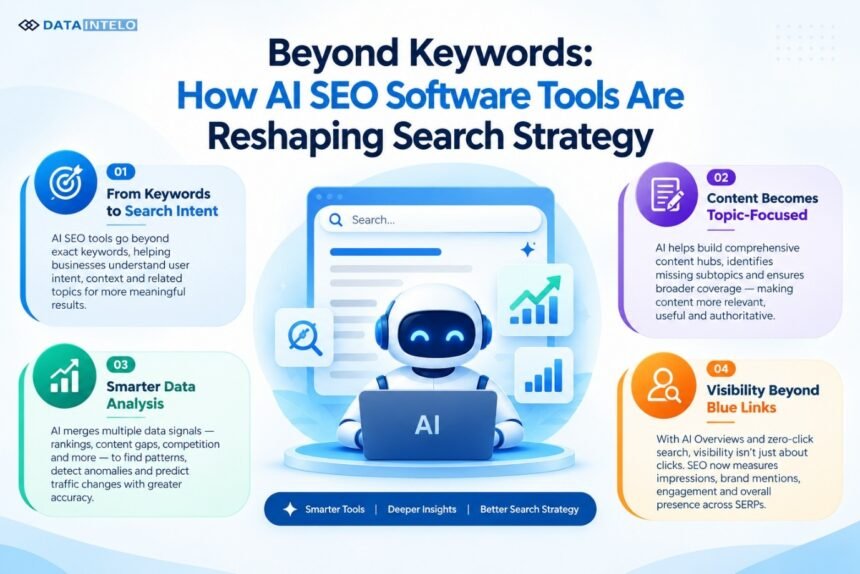
SEO has always revolved around keywords, backlinks, metadata, and rankings, but times are changing because search engines are now starting to focus on meaning instead of just the words used. SEO software tools are helping things change because they enable businesses to understand search intent, relationships between content, user behavior, and the evolving search results.
Simultaneously, the global ecosystem of SEO software has grown at the same time as the entire field of artificial intelligence, with the use of AI shifting from a research phase into a common practice in the digital workflow.
The Move from Keywords to Intent
Keyword volumes have been the dominant factor in SEO for over two decades now. However, a specific keyword can have a multiplicity of meanings in search terms. A search with four to six terms can produce results covering anything from research intentions to buying motives depending on the context.
Artificial intelligence systems apply the knowledge gathered from thousands of queries unlike earlier approaches where each search query was treated separately. The information drawn from natural language processing allows establishing communication between expression results, subjects, and queries, making semantic relevance more significant than ever before. When the topic of a text covers from 15 to 30 interrelated concepts, the text will have a stronger topic making than a text that uses the same keyword in 10 or 20 times.
In addition, AI significantly facilitates the process of detecting anomalies. For example, one might easily identify any anomaly by observing a sudden decrease in organic traffic by 20%, changes in the ranking by 15%, or an enormous increase in impressions by 30%.
The Advancement of AI in Search Data Analysis
Traditionally, Search Engine Optimization (SEO) analysis is always conducted using different datasets, which include the rankings, the competition analysis, the content gaps, and the search volume. However, with the invention of AI-powered SEO tools, these separate signals are merged and then analyzed for the patterns. The consistent growth of the industry underlines that many companies adopted this technology.
According to a report from Data Intelo, the value of the global AI tools market for SEO is going to be evaluated at $3.8 billion by 2025, while, at the same time, it is predicted to reach $14.6 billion by 2034 (Graph 1), which means a CAGR of 16.2% from 2026 till 2034. This growth is caused by machine learning, natural language processing, and generative AI champions in the SEO process.
For instance, a person who analyzes 500 keywords may have to classify the query intention, find competing pages, and group similar queries. Automated technologies can analyze thousands of keyword records in much less time. This is important, as search behavior is changing all the time. A request with 10,000 searches a month may either drop or gain considerable visibility due to any news, technological innovations or products, or changes in consumer behavior.
Also, the use of AI makes anomaly detection a walk in the park. For instance, a sudden decrease of 20% in organic traffic, a fall of 15% in position, or an increase of 30% in impressions may suggest the appearance of new content or changes in algorithms and search demand.
Content Strategy Shifts Focus Toward Topics
AI SEO tools influence the organization of content portfolios, making it possible to create one single hub page with several smaller pages, instead of creating 20 pages with slightly different keywords.
A common cluster may have one main page with 5–10 additional articles and dozens of questions connected with the topic. AI tools can help identify what sub-focuses are missing by analyzing the semantics of competitive sites.
This method works especially well for complicated topics. For instance, a technology-related article may require covering such points as definition, use, price, safety, implementation, limits, and other aspects. A page covering only 2 or 3 of these points will be less informative than one covering 10 or more dimensions.
The Importance of Conversational Search
Conversational searching is the next big advancement in search technology. As a growing number of users turn to AI systems for their searches, their query lengths increase as well.
While a normal keyword search could probably only involve 2 to 4 keywords, a conversational search could be formed of more than 10 or 15 words. Such an inquiry would carry contextual specifications, limitations, and even questions that arise along the way. This implies that SEO instruments will analyze more than the standard keyword matching.
For an illustration, compare the two query types:
| Conventional SEO Signal | AI-Based SEO Signal |
| Keyword frequency | Semantic relevance |
| Search volume | Search intent |
| Exact-match phrases | Related entities |
| Ranking position | Visibility across results |
| Backlink quantity | Contextual authority |
| Page optimization | Comprehensive topic coverage |
The table highlights a broader change: SEO measurement is moving from individual terms toward relationships among queries, content, entities, and search experiences.
Five Areas Receiving Greater Attention
AI SEO software is expanding beyond conventional rank tracking. Current strategies increasingly examine multiple layers of search visibility:
- Entity recognition: Identifying individuals, businesses, goods, places, and ideas associated with the subject.
- Intent classification: Classifying queries as information-, navigation-, commercial-, or transaction-related.
- Content gaps: Identifying topics that competing sites are talking about but that aren’t addressed in any existing materials.
- SERP analysis: Watching changes in highlighted snippets, AI-generated responses, clips, photos, and other formats of results.
- Performance forecasting: Analyzing past patterns to predict traffic fluctuations in peak-content conditions.
Each area adds another measurable dimension. A content team managing 200 pages, for instance, can evaluate dozens of attributes per page rather than relying on 1 primary keyword and a ranking position.
AI Overviews and the Changing Meaning of Visibility
AI-generated search experiences are creating another challenge: visibility no longer necessarily means receiving a traditional blue-link click. Search engines can summarize information directly within results, potentially changing how users interact with websites.
The condition is changed by different metrics. Hence, the page of the website could have a lower CTR today compared to the previous time due to the increase of the number of impressions per page. The growth of the impressions could be 25% while CTR has decreased. Thus, these changes oblige SEO experts to take different things into account, such as impressions, backlinks, brand mentions, engagement, and the overall conversion rate.
The concept of zero-click search is therefore becoming more significant. Visibility can occur through an answer, featured result, knowledge panel, or AI-generated summary without producing a conventional website visit.
New Research Prioritizes Quality and Context
In past years, AI search research really focuses on the quality of information, factual accuracy, and contextual relevance. It is possible for huge language models to analyze thousands of parameters, but their size does not mean accurate answers.
That translates into a necessity to have evidence-based content for SEO. Statistical data such as dates, definitions, and technicalities must be coherent over a number of pages. A site with 100 articles with conflicting data can give lesser informational signals than 30 pages that are kept up-to-date.
Moreover, it is essential to ensure content freshness even for the most fast-moving industries. Information may be outdated in 6 to 12 months. Therefore, it is worth reviewing contents every 3, 6, or 12-month periods depending on the changes of regulations, technologies, and other market conditions.
The Next Stage of SEO Measurement
AI SEO software isn’t replacing conventional SEO indices. Rather, it’s complementing them. Rankings, links, organic traffic, and click-through ratio, while valuable, are now on par with new KPI metrics, which include search intent, search visibility, information quality, and AI result visibility.
The transition can be explained in terms of scale. SEO used to worry about individually optimized pages targeting one primary keyword. Today, search strategy examines a single topic on several pages, various related terms, and various SERP formats.
Thus, the future is about more than just keyword searching; it is understanding how the information is searched, processed, linked, and represented. As search engines are improving, AI SEO performance will be increasingly related to the quality of the surrounding information ecosystem.