


Short answer: AI images for SEO are safe to use when you treat them like any other asset: check them by hand, write real alt text, compress them, and keep an AI label in the file. On copyright, the US Copyright Office said in January 2025 that purely AI-generated images are not protected. Only the human-made parts are.
Key takeaways
- Prompts alone do not make you the author. The US Copyright Office’s 2025 report says human selection, arrangement or creative edits can be protected.
- Google does not ban AI images. It asks you to review AI output, including alt text, before publishing.
- The label that matters is IPTC DigitalSourceType. Google Merchant Center requires it on AI-generated product images.
- Compression and format changes can leave a file with no metadata at all. Check the file you actually serve.
- The common AI image mistakes are visual: garbled text, extra fingers, wrong product details, fake logos. A person has to catch them.
Why AI image rules matter now
The clearest rule on ownership comes from the US Copyright Office. On January 29, 2025 it published Part 2 of its Copyright and Artificial Intelligence report, on copyrightability. The Office reviewed more than 10,000 public comments before reaching its conclusions. The headline: AI output is protected only where a human author has determined enough of its expressive elements, and typing a prompt does not count.
For a publisher, that has a practical edge. If your featured image is a raw generator output, you probably cannot stop a competitor from reusing it. If you design the composition, paint over it, combine it with your own photo or arrange it into a larger graphic, those human parts can be yours.

Are AI images copyrighted?
Usually not, if nothing human was added. The 2025 report lists its conclusions plainly:
- Copyright does not extend to purely AI-generated material, or material where there is not enough human control over the expressive elements.
- With current, generally available tools, prompts alone do not give enough control.
- Human authors can claim copyright in their own work that is perceptible in an AI output, in the creative selection, coordination or arrangement of outputs, and in creative modifications of outputs.
- Using AI to assist, rather than to stand in for human creativity, does not block protection.
- Each case is judged on its own facts.
The report points back to the Office’s February 2023 decision on the comic book Zarya of the Dawn. Registration covered the human-written text and the human selection and arrangement of text and images. It did not cover the individual images, which were generated by AI.
Two things this report does not settle. First, whether an AI image infringes someone else’s work. Ownership and infringement are separate questions, and a generator can still produce something close to a famous character or a real brand’s logo. Second, rules outside the US. If you publish for other markets, check local law. This article is general information, not legal advice. Talk to a lawyer for anything high-stakes, like a product launch visual or a client campaign.
If your team is setting rules for this, our guide to writing AI usage guidelines for a content team has a template you can extend to images.
Do AI generated images hurt SEO?
Not by themselves. Google’s page on using generative AI content on your website (last updated October 2026) does not tell you to avoid AI images. It says to focus on accuracy, quality and relevance, and to fact-check AI output by hand. It names alt text for images as one of the things that review covers, because alt text can appear in search results.
The risk sits elsewhere. The same page warns that generating many pages without adding value may break Google’s spam policy on scaled content abuse. A thousand thin posts with a generator image on each will not be saved by the images. For the wider trust question, see our practical guide to AI content ethics.
The ranking basics for AI generated images are the same as for photos. Google’s image SEO best practices call alt text the most important attribute for image metadata, ask for short descriptive filenames (its example: my-new-black-kitten.jpg beats IMG00023.JPG), warn that keyword-stuffed alt text can be treated as spam, and list the supported formats: BMP, GIF, JPEG, PNG, WebP, SVG and AVIF.
How to label AI images with IPTC metadata
The industry label is an IPTC field called Digital Source Type. Google’s documentation on image metadata in Google Images lists the values it supports:
| Value | Use it when |
|---|---|
| trainedAlgorithmicMedia | The whole image came from a generative model. |
| compositeWithTrainedAlgorithmicMedia | You mixed AI output with other media, for example inpainting or outpainting a real photo. |
| compositeSynthetic | The image is a composite with at least one synthetic element. |
| algorithmicMedia | Pure algorithm output not based on training data, such as a chart drawn by code from a formula. |
For most blogs this is good practice. For ecommerce it is a rule. Google’s Merchant Center policy on AI-generated content says all images created with generative AI must carry the TrainedAlgorithmicMedia tag, and tells sellers not to remove it.
Some AI tools embed this tag for you; Merchant Center names Google’s own Product Studio as one. The problem is what happens next. Resizing, cropping, converting to WebP or running a compressor can produce a file with none of the original metadata. If you need to add the tag yourself, ExifTool can do it in one line, for example:
exiftool -XMP-iptcExt:DigitalSourceType="http://cv.iptc.org/newscodes/digitalsourcetype/trainedAlgorithmicMedia" featured.webp
Run it on the final file, after compression, then re-check.
If you publish to EU audiences, also know Article 50(4) of the EU AI Act, which applies from 2 August 2026. Deployers who use AI to generate or manipulate an image that counts as a deep fake under Article 50, meaning it resembles real people, objects, places or events and would falsely appear authentic, must disclose that it was artificially generated. Evidently artistic, creative or satirical work gets a lighter disclosure duty. A stylised blog illustration is unlikely to be a deep fake. A realistic “photo” of a real CEO at an event that never happened is exactly what the rule targets.
A 7-step workflow for AI images for SEO
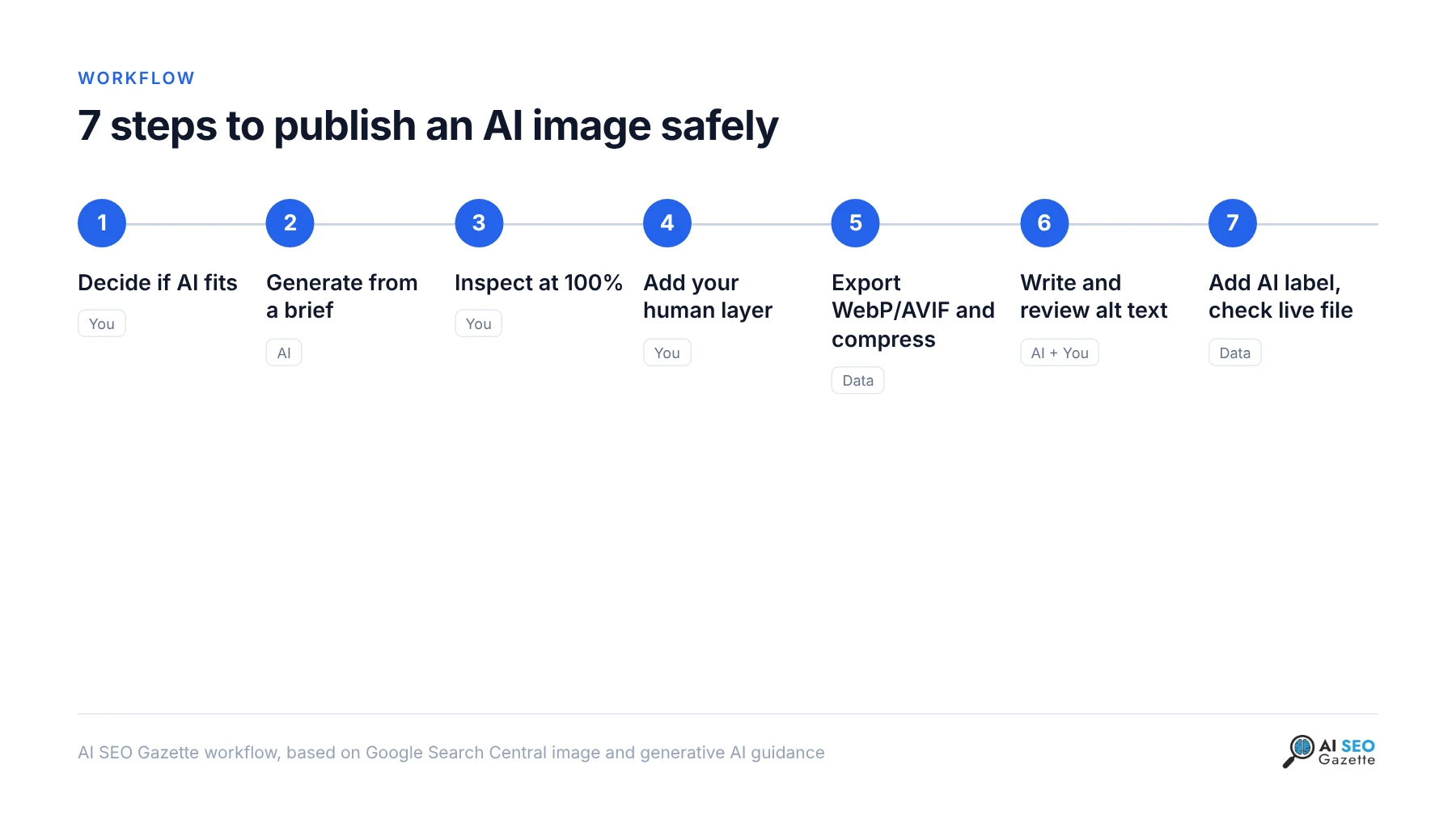
- Decide if AI is the right source. Use the decision table below. Screenshots, product shots and real people should usually be real.
- Generate with a brief, not a one-liner. Describe the composition, style and what must not appear (text, logos, faces). You can browse options in our AI image generator directory.
- Inspect at 100% zoom. Run the manual checks in the next section before anything else.
- Add your human layer. Crop, recompose, add your own chart, data or photo, and fix errors. This is better content, and per the 2025 report it is the part that can be protected. A tool like Edit Text in Image handles the common fix of replacing garbled lettering.
- Export and compress. Save as WebP or AVIF with a short descriptive filename. Browser tools such as NeatCompress or the Free Image Compressor Online do this without design software.
- Write alt text, then review it. An AI describer like Image Describer gives a fast first draft. Edit it so it describes what the image shows in the context of your page, with no keyword list.
- Label and verify the served file. Add or confirm the DigitalSourceType tag on the final file, upload it, then download the live URL and check that the tag and your alt text survived.
If you want this folded into a broader stack, our AI tools stack for solo bloggers shows where image tools sit alongside research and writing.
What we found when we checked our own images
We ran this checklist on AI SEO Gazette itself in November 2026. We fetched the live pages, pulled each image’s served file and alt text, and inspected the bytes for an EXIF, XMP or IPTC block. Two samples:
- Sample A: 19 featured and in-article images from six guides published in November 2026, including the posts on AI content ethics, content audits and AI detection tools.
- Sample B: the four featured images uploaded on 25 December 2025, one of them on our five-step framework for editing AI content for E-E-A-T.
| Check | Sample A (19 images) | Sample B (4 images) |
|---|---|---|
| Descriptive filename | 19 of 19 pass, for example reader-comfort-ai-generated-news-2026.webp | 0 of 4. Each starts can-you-create-a-blog-feature-image-for- and ends in a random 40-plus character string |
| Alt text describes the image | 19 of 19 pass, 76 to 172 characters, no keyword lists | 0 of 4. The alt text is the filename plus “| | AI SEO Gazette”, and it renders that way on the live page |
| Modern format, light weight | 19 of 19 WebP, 16.1 KB to 73.0 KB | JPEG, 1312 x 736 px, 76.6 KB to 128.2 KB |
| Embedded source metadata | 0 of 19 carry any EXIF, XMP or IPTC block | Basic EXIF only (orientation, resolution). No DigitalSourceType |
Sample B is the classic failure. The filename reads like the start of a prompt, which suggests the images were saved straight from a generator and uploaded as is. That one shortcut broke three checks: filename, alt text and labelling. The fix is a short job per image: re-export as WebP with a real name, rewrite the alt text, add the DigitalSourceType tag.
Sample A shows the quieter problem. The SEO basics are clean, but none of the 19 served files carries metadata. We cannot tell from the files whether a label was never added or was dropped during WebP conversion, and that is the point. Neither can Google, a Merchant Center reviewer or a reader. Data charts drawn from cited figures do not need an AI label, but any AI illustration in that pipeline would lose its label the same way.
You can run the same audit as part of a regular evergreen content audit: add filename, alt, format and metadata as four columns.
When should you use an AI image?
| Image job | AI image? | What to check |
|---|---|---|
| Blog featured image or concept illustration | Yes | No stray text or logos, alt text, label |
| Chart or stat graphic | No, draw it from the data | Numbers match the source, source line on the image |
| Product photo or listing image | Only for lifestyle scenes, with care | Product details match the real item, TrainedAlgorithmicMedia tag for Merchant Center |
| Screenshot of a tool or SERP | No | Take a real screenshot, date it |
| Team, author or customer photo | No | Use real people with consent |
| Realistic scene of a real person, brand or event | Avoid | If used, disclose it. EU deep fake rules may apply |
| Tool founder’s launch or hero visual | Yes, as a base | Add your own UI and branding so the final work has human authorship |
Where AI images go wrong: manual checks
AI detectors will not catch these, and neither will an SEO crawler. Someone has to look. Our piece on using AI detection tools without killing good content covers why automated flags are a weak substitute for review.
- Garbled text. Signs, labels, book covers and UI screens often come out as near-words. Zoom in and read every letter, or remove the text.
- Hallucinated or lookalike logos. Generators invent marks that resemble real brands. A near-copy of a known logo is a trademark risk, whatever the copyright position.
- Wrong product details. Port counts, button layouts, colours and packaging drift. If a reader buys based on the image, it must match the real product.
- Fake people. Realistic faces next to testimonials or “our team” copy mislead readers. Check hands, ears, teeth and jewellery for glitches, then ask whether a real photo should be there instead.
- Close copies of known work. Prompts that name an artist or a character can return something very close to protected work. Reverse-search the output before you publish.
- Charts that look like data. A generator will happily draw a bar chart with invented values. Never use AI for a chart that readers will read as fact.
- Alt text that describes a different image. AI-written alt text sometimes describes what the prompt asked for, not what the image shows. Read it with the image in front of you.
Frequently asked questions
Can I copyright an image I made with an AI image generator?
Not the raw output, under the US Copyright Office’s January 2025 report. Prompts alone are not enough. You can claim the parts you add yourself: creative edits, your own photo or drawing inside the image, or the way you select and arrange several outputs into a larger work.
Does Google penalize AI generated images?
No. Google’s guidance on generative AI content asks for accuracy, quality and relevance, and a human review of AI output including alt text. The penalty risk comes from mass-producing low-value pages, which falls under its scaled content abuse policy.
Do I have to label AI images on my blog?
For Google Merchant Center product images, yes: they must carry the IPTC DigitalSourceType TrainedAlgorithmicMedia tag. For ordinary blog images, Google suggests giving readers context, such as image metadata, but does not require it. In the EU, realistic deep fakes must be disclosed from 2 August 2026.
Does compressing an image remove the AI label?
It can. Resizing, converting to WebP or running a compressor may write a new file without the original metadata. In our November 2026 check, none of 19 served WebP images on this site carried any metadata block. Add or re-check the tag on the final file you upload.
Should alt text say an image is AI-generated?
Usually not. Alt text should describe what the image shows for people who cannot see it. Put the AI disclosure in the file’s metadata and, where it helps readers, in a caption.
Sources
- U.S. Copyright Office, Copyright and Artificial Intelligence, Part 2: Copyrightability (January 2025). copyright.gov
- U.S. Copyright Office, NewsNet Issue 1060: Copyright Office Releases Part 2 of Artificial Intelligence Report (January 29, 2025). copyright.gov
- Google Search Central, Google Search’s guidance on using generative AI content on your website. developers.google.com
- Google Search Central, Image SEO best practices. developers.google.com
- Google Search Central, Image metadata in Google Images. developers.google.com
- Google Merchant Center Help, AI-generated content. support.google.com
- EU Artificial Intelligence Act, Article 50: Transparency obligations for providers and deployers of certain AI systems. artificialintelligenceact.eu