

Prompt engineering for SEO is the practice of writing clear instructions for AI models so they produce useful search content: briefs, outlines, drafts, meta descriptions and FAQs. A good prompt names the task, the reader, the search intent, the source material, the output format and the limits. You then fact-check and edit everything the model returns.
Most people who get weak output from ChatGPT or Claude blame the model. Usually the prompt is the problem. This guide covers prompt engineering basics for SEO pros and tool founders who want better first drafts without publishing generic AI text. If you already write structured prompts, skip ahead to our advanced prompt engineering framework for content at scale.
Key takeaways
- A prompt works best when it reads like a brief you would hand a new freelancer: task, reader, intent, inputs, format, limits.
- Feed the model real data (your keyword, SERP notes, product facts). Models predict words; they do not look up facts for you.
- Ask for one job per prompt. “Write a meta description” beats “write the whole post and optimize it.”
- Ahrefs found only 4.6% of top-ranking pages were pure AI in its 2025 study. Human editing still sits between the prompt and the publish button.
- Google’s guidance asks you to fact-check all AI-generated content, including alt text and metadata, before it goes live.
Why prompt engineering for SEO matters
In July 2025, Ahrefs ran 600,000 pages through its AI content detector. The sample was the top 20 ranking URLs for 100,000 random keywords. The Ahrefs study found 4.6% of those pages were pure AI, 13.5% were pure human and 81.9% mixed human and AI writing. The correlation between AI share and ranking position was 0.011, which Ahrefs called “effectively zero.”
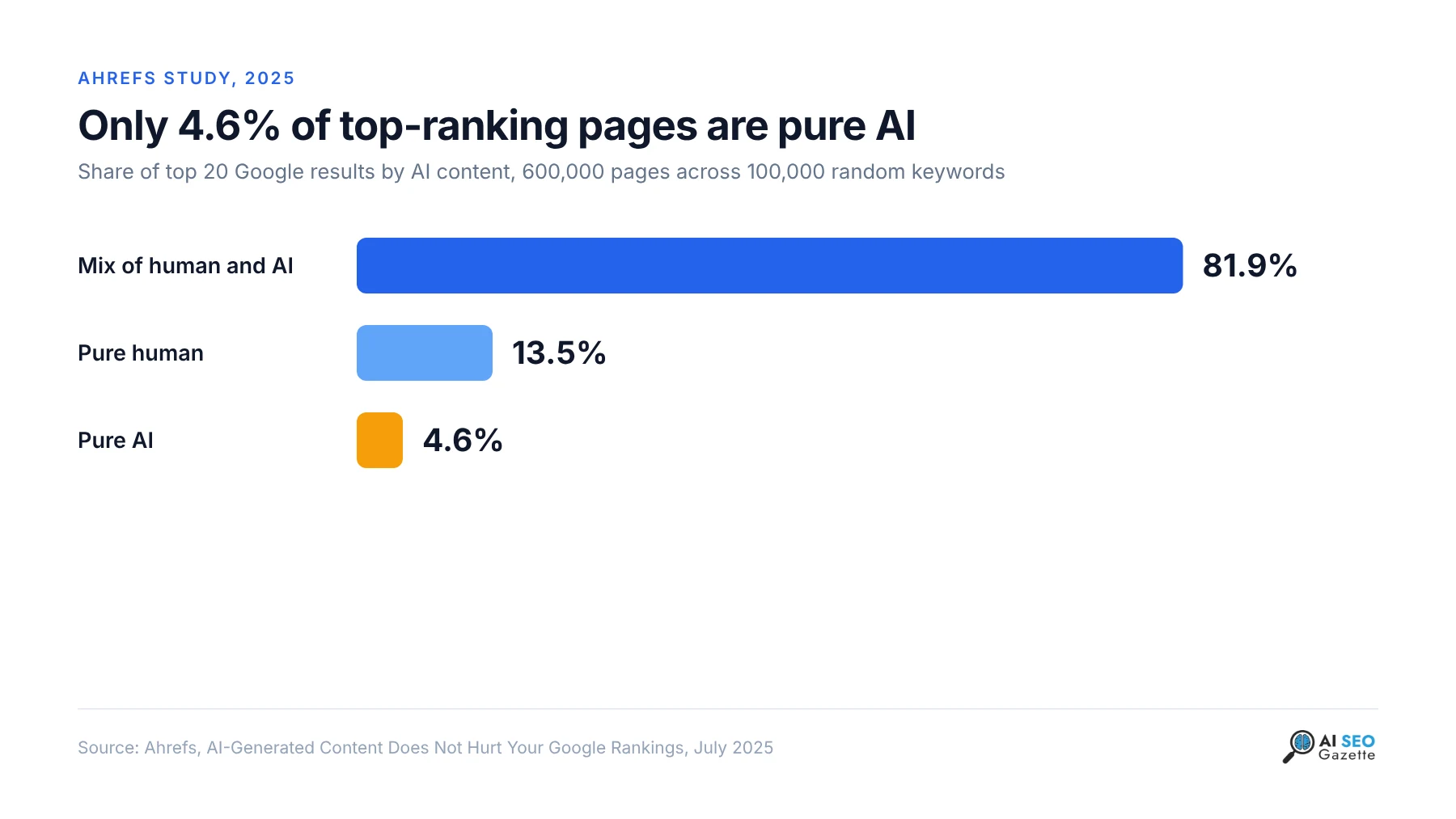
Two things follow. Google is not filtering out AI-assisted pages as a class. And the pages that rank are mostly hybrids, where a person chose the angle, supplied the facts and edited the output. Ahrefs notes that no AI detector is perfect, so treat the split as directional. Still, the pattern is clear enough: the quality of your instructions and your edit decides what you publish, not the tool you used.
Google says the same thing in plainer terms. Its guidance on generative AI content (Google Search Central, updated 2026) says AI “can be particularly useful when researching a topic, and to add structure to original content.” The same page warns that generating many pages without adding value for users may break the spam policy on scaled content abuse. Good prompts are how you get the first benefit without drifting into the second.
What makes a good prompt? Prompt engineering basics
Anthropic’s prompting best practices describe the model as “a brilliant but new employee who lacks context on your norms and workflows.” Their test is simple: show your prompt to a colleague with little context. If they would be confused, the model will be too.
OpenAI’s best practices for prompt engineering make similar points. Put instructions first. Be specific about context, outcome, length, format and style. Cut “fluffy” descriptions. Say what to do instead of only what not to do.
For SEO work, that boils down to six parts:
- Task: one clear job, such as “write five H2s” or “write a meta description under 155 characters.”
- Reader: who searches this and what they already know.
- Search intent: what the searcher wants to do after reading.
- Inputs: the facts the model must use. Paste them in.
- Format: length, headings, table or list, reading level.
- Limits: words to avoid, claims it must not make, and what to do when it lacks information.
You do not need fancy syntax to start. Labels in capital letters or simple dividers like ### are enough to keep your instructions apart from your pasted data.
A 5-step prompt workflow for SEO content
This is the loop we use for small, single-purpose prompts. It fits inside a larger AI-assisted content workflow from idea to publish.
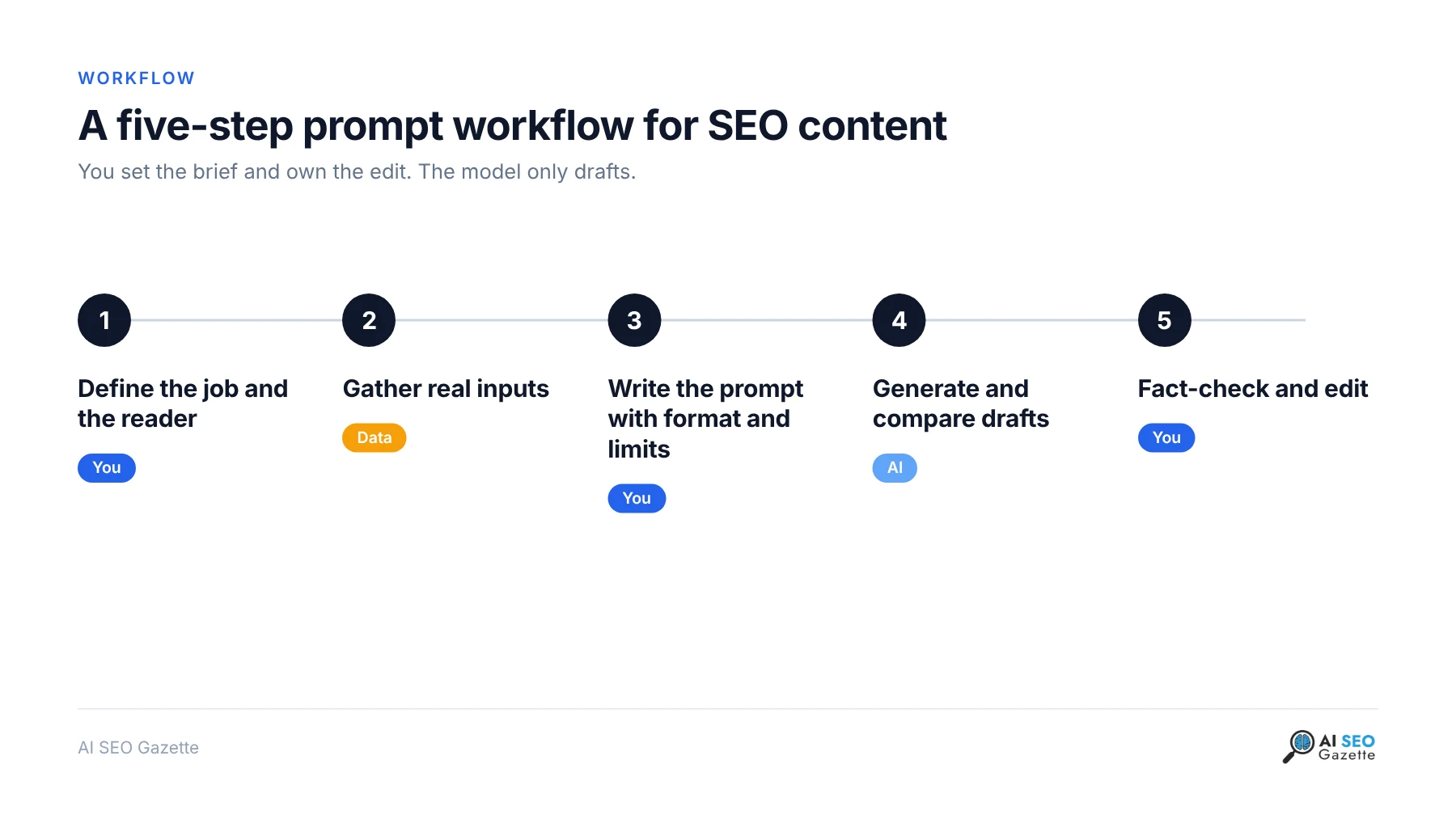
- Define the job and the reader (You). Pick one output. Write down who searches the keyword and why.
- Gather real inputs (Data). Keyword, top-ranking angles, product facts, stats with sources, your own experience. A keyword tool like kwrds.ai can give you related queries and intent labels to paste in.
- Write the prompt with format and limits (You). Use the template below.
- Generate and compare drafts (AI). Ask for two or three options when the output is short, like titles or meta descriptions.
- Fact-check and edit (You). Verify every number, name and claim against the source. Rewrite in your own voice.
Copy-paste prompt template for SEO content
Fill in the brackets. Delete any line that does not apply. The template works in ChatGPT, Claude and Gemini.
TASK: [One job. Example: Write 3 meta description options for the page below.]

READER: [Who searches this. Example: SEO leads at small SaaS companies who already use ChatGPT daily.]

SEARCH INTENT: [What they want. Example: a ready policy template they can adapt today.]

PRIMARY KEYWORD: [keyword]
SECONDARY KEYWORDS: [1 to 3 terms, use only if they fit naturally]

### INPUTS (use only these facts) ###
[Paste page title, H2s, first paragraph, product facts, stats with sources.]
### END INPUTS ###

FORMAT:
- [Length. Example: under 155 characters each, including spaces]
- [Structure. Example: numbered list, show character count after each]
- [Tone. Example: plain, direct, second person]

LIMITS:
- Do not add facts, numbers or features that are not in INPUTS.
- If something you need is missing, ask me instead of guessing.
- Avoid filler phrases like "discover everything you need to know."

Before you answer, list any assumptions you made.
The last two lines do a lot of work. Telling the model to ask when information is missing cuts invented details. Asking it to list assumptions shows you where it filled gaps.
Once you have prompts that work, save them. A prompt manager like Gud Prompt lets you bookmark and reuse ChatGPT prompts, so your team stops rewriting the same brief every week.
Weak vs strong ChatGPT prompts for content: a worked example
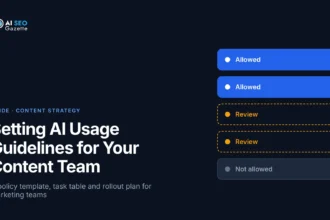
Here is the template applied to a real Gazette page: AI content guidelines: policy template for teams. The inputs below are the page’s actual title, H2s and opening answer. The model outputs are illustrative examples written to show typical results. They are not a logged test of a specific model.
Weak prompt:
Write a meta description for a blog post about AI content guidelines.
Typical output (illustrative):
Discover everything you need to know about AI content guidelines. Learn best practices and expert tips to create effective policies for your team today!
It is 152 characters, so length is fine. Everything else is weak. It promises “everything,” mentions nothing the page actually offers and could sit on any of a thousand pages.
Strong prompt (using the template):
TASK: Write 3 meta description options. READER: content managers setting rules for writers who use AI. INTENT: they want a policy they can copy and adapt. PRIMARY KEYWORD: AI content guidelines. INPUTS: Title “AI Content Guidelines: Policy Template for Teams.” Sections include a copy-paste AI usage policy template, an AI task decision table (allowed, allowed with review, not allowed), a five-step rollout plan and manual checks. FORMAT: under 155 characters, keyword in the first half, name at least two things the page contains. LIMITS: no facts outside INPUTS, no “discover” or “ultimate.”
Typical output, best option (illustrative):
AI content guidelines your writers will follow: a copy-paste usage policy, a table of tasks that need human review and a 5-step rollout plan.
That version is 141 characters. It names three real assets on the page and matches the searcher’s intent. For comparison, the live meta description on that page follows almost the same pattern. That is the point: a strong prompt gets you close to what a careful editor would write, and the editor still makes the final call.
Which SEO tasks suit AI prompts?
Not every task deserves a prompt. Use this table as a starting point, then adjust it to your own team AI usage rules.
| Task | Good fit for AI? | What you must supply or check |
|---|---|---|
| Outline and H2 ideas | Yes | Keyword, intent, top-ranking angles |
| Meta titles and descriptions | Yes | Page facts, character limits, final edit |
| FAQ questions | Yes, with review | Real questions from customers, PAA or support tickets |
| Summarizing your own research | Yes, with review | The source document, a check that nothing was distorted |
| Statistics and citations | No | Find and read the original study yourself |
| First-hand experience, tests, opinions | No | Your own work. The model has none. |
| Bulk pages with swapped keywords | No | This is the scaled content pattern Google warns about |
Where AI gets it wrong: manual checks before you publish
Google’s guidance puts it bluntly: “generative models don’t retrieve facts, but predict a likely sequence of words based on their training data.” It asks you to manually fact-check and review all AI-generated content before publishing, and that includes image alt text and metadata. Run these checks on every output:
- Numbers and studies. Models invent statistics or attach real numbers to the wrong year, sample or publisher. Open the original source every time.
- Product facts. Pricing, feature names and integrations go stale fast. Tool founders should check every claim about their own product and about competitors.
- Intent drift. Ask for a beginner guide and you may get a sales page. Compare the draft against the SERP you studied in step 2.
- Same-y phrasing. Repeated openers, stacked adjectives and empty phrases make text read as machine-made. Our guide on humanizing AI writing in ways Google trusts covers how to edit for voice. A rewriting tool like AI Natural Write can flag clunky phrasing, but treat it as a second pass after your own edit.
- Missing experience. If the draft has no detail only you could know, such as a test result, a screenshot or a client lesson, add one.
- Links. Models produce URLs that look right and 404. Click every link.
How do you improve a prompt that keeps failing?
Change one thing at a time so you can see what fixed it. Common fixes:
- Output is generic: add more inputs. Paste your notes, a customer quote or a section of the source.
- Output is the wrong shape: show an example. Anthropic recommends 3 to 5 examples for best results when you want consistent formatting.
- Output ignores a rule: explain why the rule exists. Anthropic’s docs note the model “can generalize from the explanation.”
- Output invents facts: tell it to answer only from INPUTS and to say “not in inputs” when it cannot.
- Output is too long: give a number, such as “under 120 words,” instead of “keep it short.”
If you research and draft in one place, a workspace such as YouMind keeps your collected sources next to the AI, which makes pasting real inputs faster. You can compare more options in our AI writing tools directory.
What to learn after the basics
Once single prompts work, the next step is chaining them: one prompt for the brief, one for the outline, one for each section, with your edits in between. Our advanced prompt engineering framework covers role assignment, delimiters, build order and few-shot examples for teams producing content at volume. If you are new to AI search in general, start with the beginner’s guide to AI SEO.
Frequently asked questions
Does Google penalize content written with AI prompts?
No, not because AI was used. Google’s guidance says AI can help with research and structure. What it targets is low-value content, including many pages generated without adding value for users. Ahrefs’ 2025 study of 600,000 pages found a correlation of 0.011 between AI share and ranking position.
Do I need to learn special syntax to write good prompts?
No. Plain labels like TASK, INPUTS and FORMAT, plus a divider such as ### around pasted data, cover most SEO work. XML tags and few-shot examples help with longer, repeatable prompts, which our advanced framework covers.
Should I use ChatGPT or Claude for SEO content?
Both follow the same basic principles: clear task, real context, explicit format. OpenAI and Anthropic publish similar advice. Test the same prompt in each on your own content type and keep whichever needs less editing.
Can AI write my statistics and sources?
It should not. Models predict likely text, so they can produce numbers and citations that look real but are wrong. Find the original study, read it and cite it yourself.
How long should an SEO prompt be?
Long enough to include the task, reader, intent, inputs, format and limits. For a meta description that might be 100 words plus pasted page facts. Length matters less than whether a colleague could follow it without asking questions.
Sources
- Ahrefs (2025). AI-Generated Content Does Not Hurt Your Google Rankings (600,000 Pages Analyzed).
- Google Search Central. Google Search’s guidance on generative AI content on your website.
- Google Search Central. Spam policies for Google web search: scaled content abuse.
- Anthropic. Prompting best practices (Claude Platform Docs).
- OpenAI Help Center. Best practices for prompt engineering with the OpenAI API.