
Most founders judge their directory listings at the worst possible moment. Thirty days after launch, the spike is over, the dashboards look flat, and it feels natural to conclude that the listings “didn’t work”. But day 30 only tells you which channels produced a burst. It says very little about which ones will still be sending people in month three, and those are the ones worth your maintenance time.
This piece starts where launch-week measurement ends. It assumes you already tag your links, keep a simple channel sheet and ask new users how they heard about you. The question now is different: which listings decay, which ones compound, and what you should do about each.
1. Why day 30 isn’t the verdict
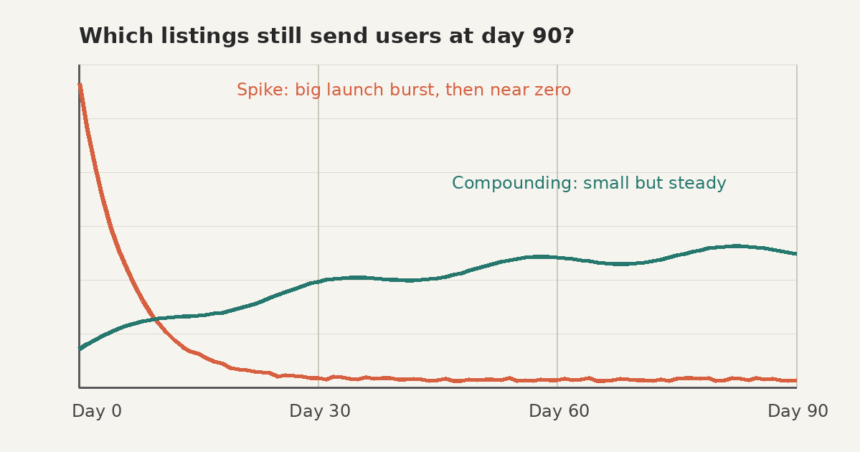
A listing can behave in one of two ways after launch.
Some decay. They send a burst while your product sits on a “new” or “featured” page, then fall to almost nothing once newer launches push you down. Launch platforms and daily feeds tend to work like this by design.
Others compound. They keep showing up for people who are actively looking: someone searching for “[your product] alternatives”, a category page that keeps getting crawled, a comparison page that ranks for a buyer query. Their traffic is small, but it is steady, and it often arrives with more intent than the launch spike did.
The difference rarely shows in the first month. A compounding listing can look worse than a decaying one at day 30, simply because it never had a spike. If you stop looking then, you prune the wrong channels.
2. Four early signs a listing will last
You don’t have to wait 90 days for every signal. Four checks, done around week three or four, predict persistence fairly well.
The listing page is indexed. Search for the exact URL, or use a site: search on the directory’s domain with your product name. Google’s own documentation describes the site: operator as a quick way to see what it has indexed for a domain, though it is not a complete list. If your page isn’t there after a few weeks, it can’t send search traffic, however good the directory looks.
It ranks for buyer queries. Search “[your product] review” and “[your product] alternatives”. If a directory page or a comparison page shows up on the first page for those, it is in front of people who are close to a decision.
It sits on pages that keep getting crawled and visited. A listing linked from a category page, a tag page or a regularly updated list keeps being found. A listing that is only reachable from a “new this week” feed tends to disappear when the feed moves on.
It gets mentioned in AI answers for your category. Ask a few assistants the questions your buyers would ask and note which pages they cite. If a directory or review page is cited, that page is part of how your category gets explained, whether or not anyone clicks.
3. Measuring persistence without paid tools
Three free measurements are enough.
A monthly referral snapshot. Once a month, export referral sessions and sign-ups by source from your analytics and paste them into your channel sheet. Google Analytics documents how UTM-tagged URLs populate source, medium and campaign, so tagged listings can be separated from plain referrers. Keep the export the same every month so the numbers are comparable.
Search Console brand-plus-directory queries. In the Performance report, filter queries containing your brand name and look for ones that also contain a directory or review site’s name, or words like “review” and “alternative”. These show which third-party pages people are actually using to research you.
A decay ratio. For each listing, divide month-three visits by month-one visits. A ratio close to zero means the listing was a spike. A ratio around one or higher means it is holding or growing. Sorting the sheet by this one column turns a vague feeling into a ranked list. Treat small numbers with care: a listing that went from four visits to three is noise, not a trend.
4. Followed, nofollow or no link at all
Founders often treat followed links as the only listings that count. That is too narrow.
Google has said since 2019 that rel=”nofollow”, “sponsored” and “ugc” are treated as hints rather than strict instructions, so a nofollow link is not automatically worthless for discovery. More practically, a nofollow link is still a link. People click it, and if the page ranks for a buyer query, it can send steady referrals no matter which attribute it carries.
Followed links from relevant, editorially chosen pages are still the ones most likely to help your own pages in search. Google’s spam policies are also explicit that buying links that pass ranking signals is a violation, which is one more reason to earn them rather than pay for them.
Then there are pages that mention you with no link at all. An unlinked mention on a trusted page can still matter: people search for names they have read, which shows up as brand searches in Search Console, and AI assistants summarising a category draw on the pages that describe it. You can’t measure these perfectly, but you can watch brand-query impressions over time and note which pages assistants cite.
5. Keeping good listings alive
A listing that is worth keeping is worth ten minutes a quarter.
Refresh the details. Update the description, pricing and screenshots when your product changes. Outdated prices on third-party pages confuse buyers and can turn a ready customer into a doubtful one.
Fix redirected or broken URLs. If you have changed domains or page paths, check that each listing points to a live page. Google’s documentation on redirects notes that permanent redirects pass users and signals to the new URL, but a chain of redirects or a broken link loses people along the way. Where the directory lets you edit the URL, point it straight at the final page.
Answer reviews and comments. A listing with a reply from the maker looks maintained. An unanswered question looks abandoned.
6. Independent reviews and comparison pages are the most durable “listings”
The listings that hold up best at day 90 are often not directory entries at all. They are independent reviews and comparison pages, because they target exactly the queries buyers type (“[product] review”, “[product] vs [competitor]”) and the publishers behind them have reasons to keep them updated.
You can earn these honestly. Offer reviewers real access to the product, answer their questions quickly and accept that they may criticise you. Don’t pay for positive coverage, and don’t ask for reviews without disclosure. In the United States, the FTC’s Endorsement Guides require material connections to be disclosed, and in 2024 the FTC finalised a rule banning fake reviews and testimonials. An honest three-out-of-five review that ranks will usually do more for you than a glowing one nobody trusts.
The same applies to AI agent directories, a newer category that sits somewhere between an app store and a review site. AI Agent Store is one example. The questions to ask there are the same: is the page indexed, does it rank for anything a buyer searches, and does it ever get cited?
7. A quarterly pruning worksheet
Once a quarter, give each listing one of three verdicts, using rules you wrote down before you looked at the numbers.
- Keep: the decay ratio is around one or higher, or the page ranks or gets cited for a buyer query.
- Refresh: the page is indexed and ranks, but traffic is falling. Update the description, pricing, screenshots and URL, then check again next quarter.
- Drop: the page isn’t indexed after 90 days, sends no referrals and isn’t cited anywhere. Stop maintaining it, and stop submitting to directories that look like it.
Writing the rules down first matters more than the exact thresholds. Without them, every listing gets judged by how hopeful you feel on the day, and you end up maintaining everything or nothing.
Launch week shows you who noticed. Day 90 shows you who keeps sending people. Measure for the second one, and your listings start to work like a small, steady channel rather than a one-off burst.
Related guides: where to submit your AI tool and how to build a where we are listed page.